

Note: If you're reading this in your inbox, be sure to check out the full post online—it includes great videos you won’t see in the email version!
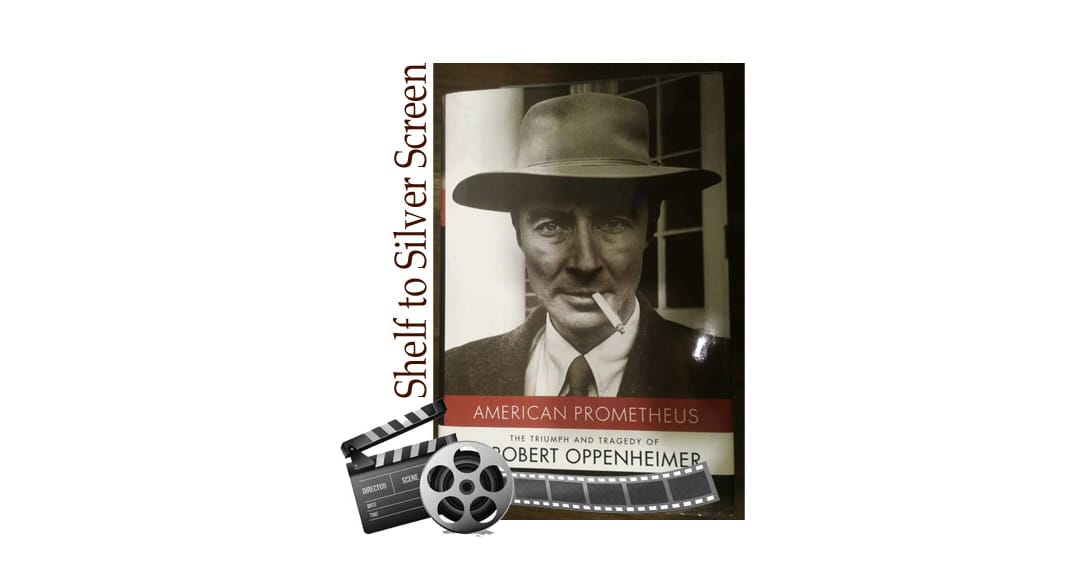
Shelf Meets Silver Screen Series

Book Awards:
- 🥇 Pulitzer Prize Winner Biography or Autobiography 2006
- 🥇 National Book Critics Circle Award Winner Biography 2005
- 🥇 Ambassador Book Award Winner Biography/Autobiography 2006
- 🥇 Pol Roger Duff Cooper Prize Winner 2008
- 🥇 J. Anthony Lukas Book Prize Finalist 2006
Oscar Awards:
- 96th Academy Awards in 2024: Nominated for 13 awards
- Won:
🏆 Best Picture
🏆 Best Director: Christopher Nolan.
🏆 Best Actor: Cillian Murphy
🏆 Best Supporting Actor: Robert Downey Jr.
🏆 Best Original Score: Ludwig Göransson
🏆 Best Cinematography: Hoyte van Hoytema
🏆 Best Film Editing: Jennifer Lam
There’s a particular chill that comes from reading American Prometheus and then watching Oppenheimer in a week when every news alert seems to whisper “nuclear” in the background. The story of J. Robert Oppenheimer feels less like distant history and more like a mirror we keep trying not to look into.
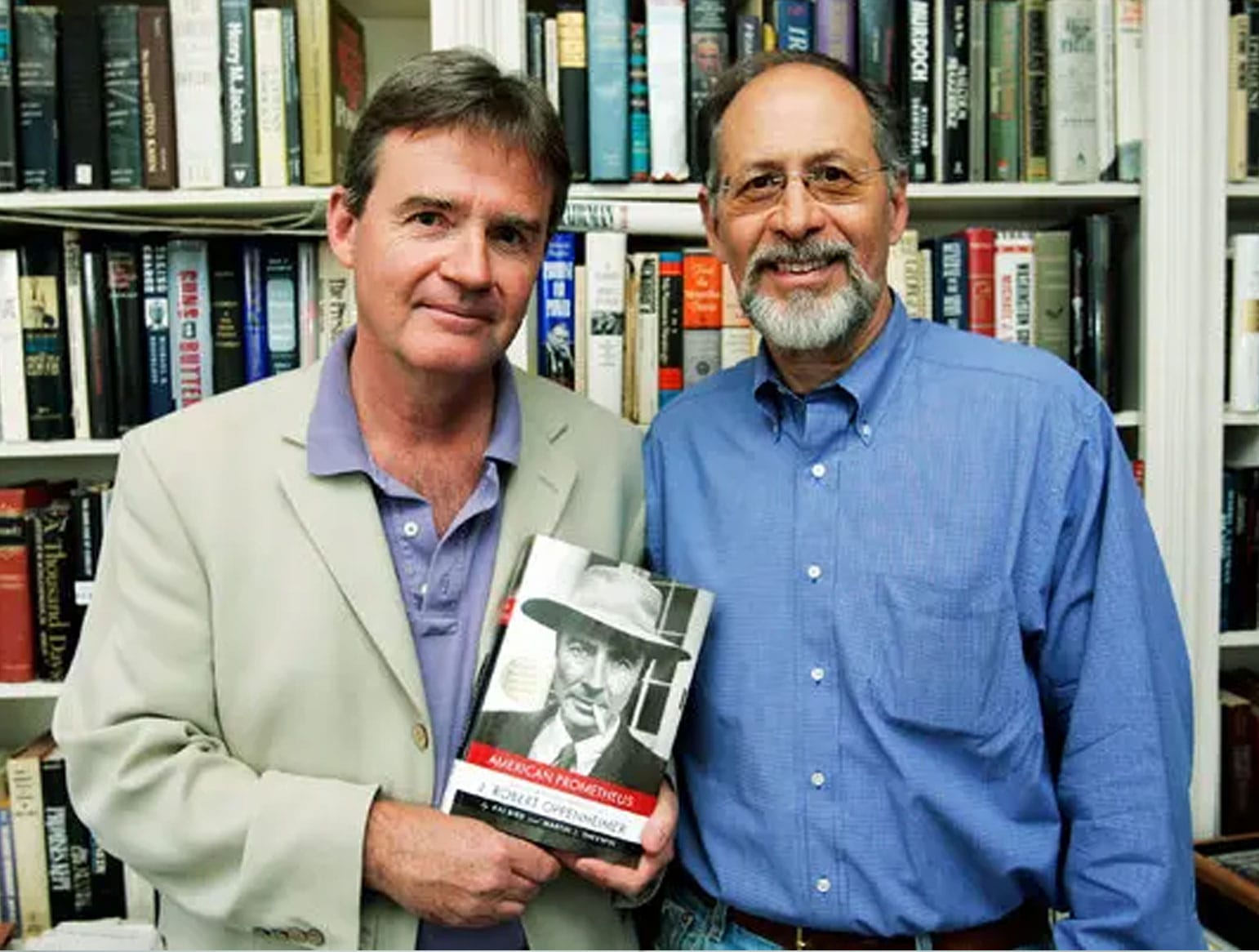
Reading American Prometheus
Kai Bird and Martin J. Sherwin call Oppenheimer a modern Prometheus for a reason: he’s the brilliant mind who “stole fire from the gods” and then lived long enough to see what humanity did with it. The biography walks you through his evolution from precocious, awkward adolescent to charismatic physicist and a kind of intellectual celebrity, someone whose mind lit up every room he entered.
What struck me most on the page was how complicated he is allowed to be: politically engaged, sometimes naive, drawn to leftist causes in the 1930s, and genuinely haunted by the human cost of what he helped create. Bird and Sherwin linger on the moral whiplash: the exhilaration of scientific discovery colliding with the images from Hiroshima and Nagasaki, and the way his doubts grow louder as the Cold War gears up. By the time you reach the security hearings, you can feel the trap closing—anxious, brilliant, imperfect Oppenheimer facing a government that now finds his conscience inconvenient.
Meeting Oppenheimer on Screen
Christopher Nolan’s film doesn’t try to compress the whole biography so much as distill its most volatile elements—the science, the politics, and the interior earthquake taking place inside one man. Cillian Murphy gives us an Oppenheimer whose genius is evident, but so is his fragility: the hollow-eyed sleeplessness, the quick flashes of arrogance, the way he always seems half a step removed from the room he’s in.
The movie’s structure feels almost novelistic, cross-cutting between timelines: the heady days at Los Alamos, the later security hearing that dismantles his reputation, and Lewis Strauss’s political machinations in the background. Color sequences track Oppenheimer’s subjective experience, while stark black-and-white frames give us the colder, more “objective” view from Strauss’s vantage point, underscoring how narratives about a man can be engineered as ruthlessly as any weapon.
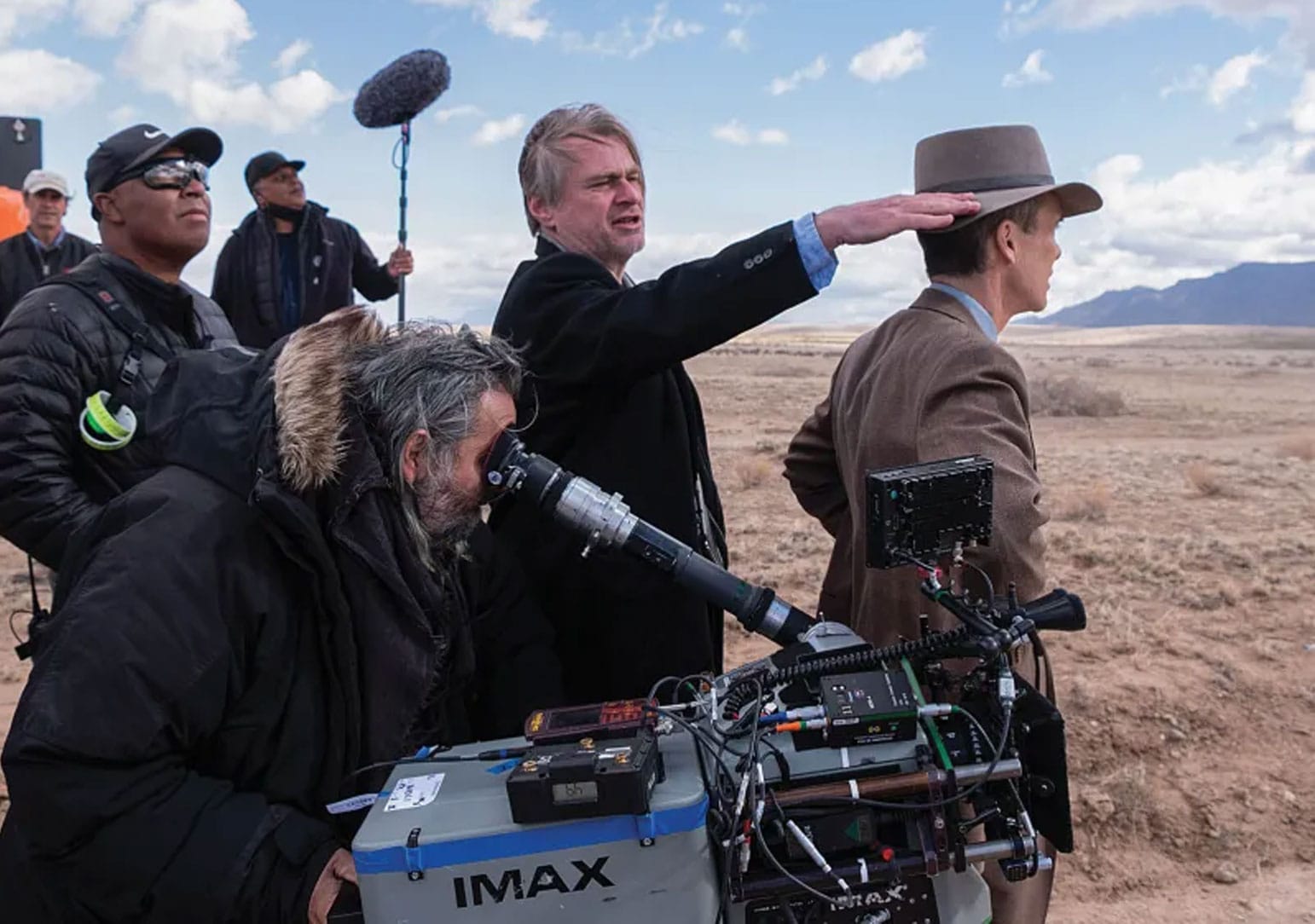
How the Film Was Made
Nolan insisted on grounding the film in analog reality as much as possible, shooting on IMAX 65mm and 65mm large-format film to give the story a tactile, almost documentary weight. The most notorious choice, of course, was staging the Trinity test without digital CGI, using practical effects, miniatures, and in-camera tricks to create that blooming, silent inferno of light and sand.
The production leans heavily on close-ups and dense sound design to make physics feel dramatic: chalkboards swarm with equations, cigarette smoke curls through crowded offices, and Ludwig Göransson’s score pulses beneath it all like an anxious heartbeat. Even when nothing “explodes” on screen, the editing and music keep you aware that the real detonation is conceptual—the moment a group of scientists realizes they have changed what it means to be human.
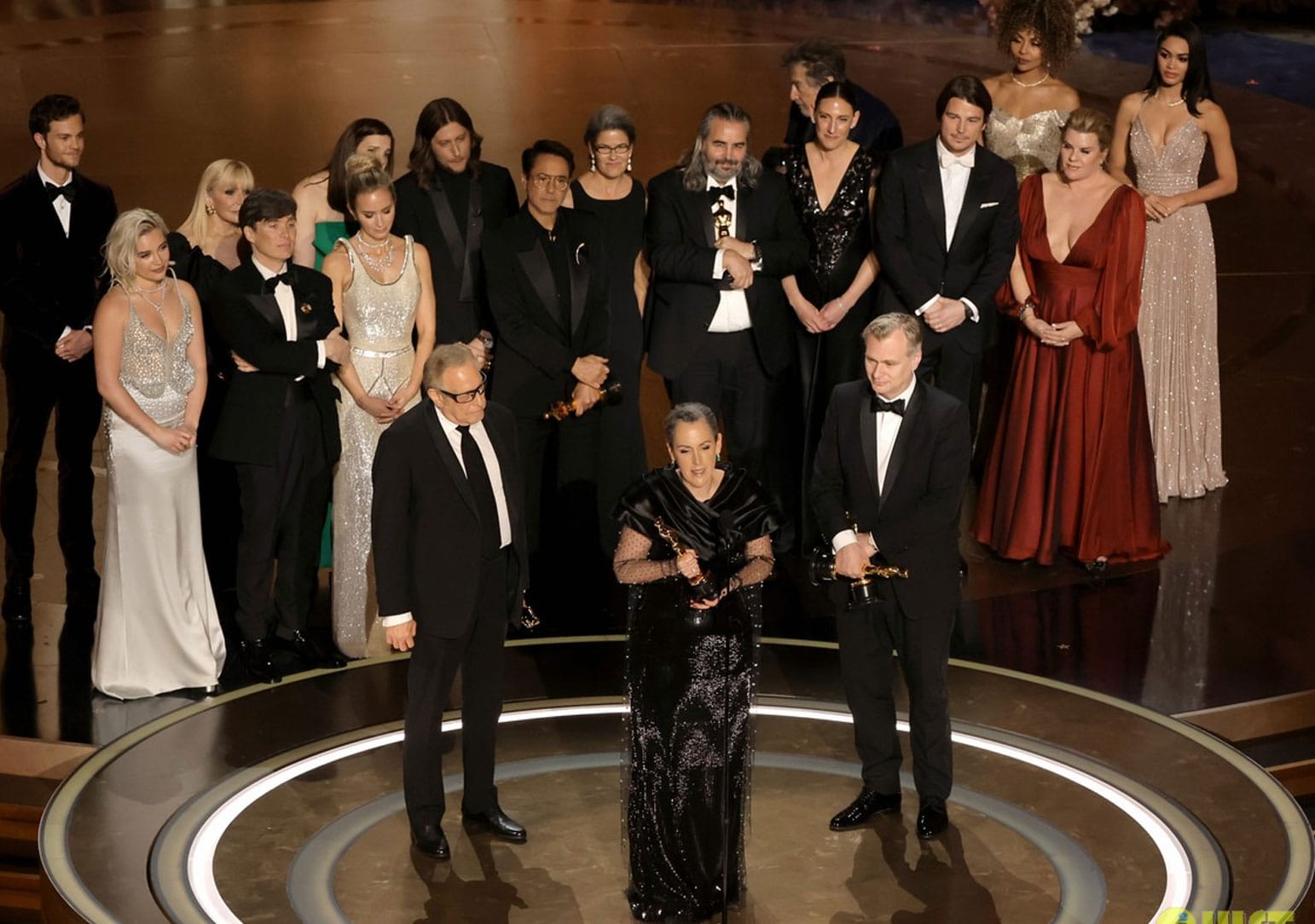
Oscar Night for Oppenheimer
For the Academy, all of this added up to a juggernaut. Oppenheimer earned 13 nominations and won 7 Oscars, including Best Picture and Best Director for Christopher Nolan, a coronation many felt was overdue. Cillian Murphy took home Best Actor for his gaunt, haunted Oppenheimer, while Robert Downey Jr. won Best Supporting Actor for his tightly coiled performance as Strauss, the bureaucratic rival who helps engineer Oppenheimer’s fall.
The film swept key craft categories as well, winning for Cinematography, Film Editing, and Original Score, recognizing how those elements fused to make a three-hour political biography feel like a thriller. It missed in areas like Costume Design, Production Design, and Sound, but its seven wins still marked it as the dominant film of its year, the rare awards-season favorite that also captured the cultural mood.
Oppenheimer, War, and the News Today
Reading American Prometheus in 2026, with the US once again embroiled in conflict and nuclear policy back in the headlines, is a queasy experience. Analysts warn about the unraveling of arms control treaties and a new arms race, and suddenly Oppenheimer’s world doesn’t feel like a closed chapter—it feels like a first act.
Both the book and the film emphasize how quickly the US government embraced Oppenheimer’s genius when it needed a weapon, then cast him aside when his doubts clashed with national security narratives. He becomes a cautionary figure: a man who wanted to use his intellect to help end a war, only to see his creation folded into an open-ended doctrine of deterrence and fear. The security hearings strip him of clearance, reputation, and influence, but they can’t undo what he helped set in motion or the way the nuclear age continues to frame every modern crisis.
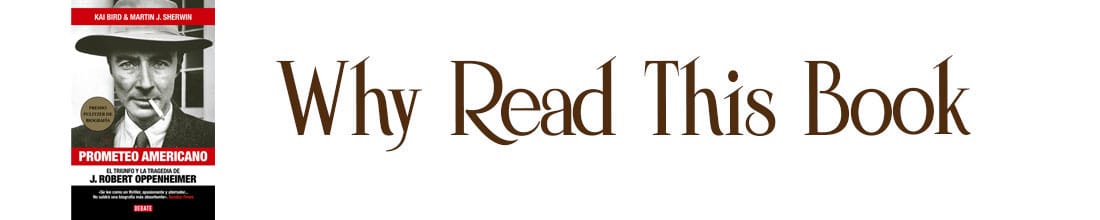
If you watched Oppenheimer and were left wondering what was fact, what was flair, and what was left out, this is the book that fills in the gaps. It’s the source behind the film, but the life on the page is even messier, more intimate, and more politically charged.
It reads like a novel, not homework
Despite the page count, the narrative moves through Oppenheimer’s childhood, his rise in physics, Los Alamos, and his downfall with the grace of a hefty literary novel. The authors spent about 25 years researching him, and you can feel that in the detail—but it’s never dry.
The ethical questions feel very 2026
Oppenheimer’s struggle with what his work unleashed speaks directly to today’s worries about nuclear weapons, technology, and what scientists owe the rest of us. The book keeps circling back to the same haunting questions: What do we do once we’ve created something we can’t take back, and who gets to decide how it’s used?
It’s a portrait of a complicated, decidedly not-perfect man
This isn’t a heroic glow-up; Oppenheimer comes across as brilliant, vain, generous, cutting, politically naïve, and often emotionally clueless. If your readers love character-driven fiction, they’ll appreciate how the book traces the fault lines in his personality all the way to that brutal security hearing.
The political drama is peak book-club material
Beyond the lab, you get Communist-adjacent friendships, FBI files, the Red Scare, and the very public unmaking of a national hero. The 1954 security hearing reads like a slow-motion train wreck—perfect for “Who was right here?” and “What would you have done?” discussions.
It shows the cost of genius on a life
You watch Oppenheimer go from precocious prodigy to world-famous scientist to sidelined, haunted public intellectual, and none of that happens without damage—to himself and to the people around him. It’s a powerful look at ambition, burnout, and what happens when your life’s work collides with history.
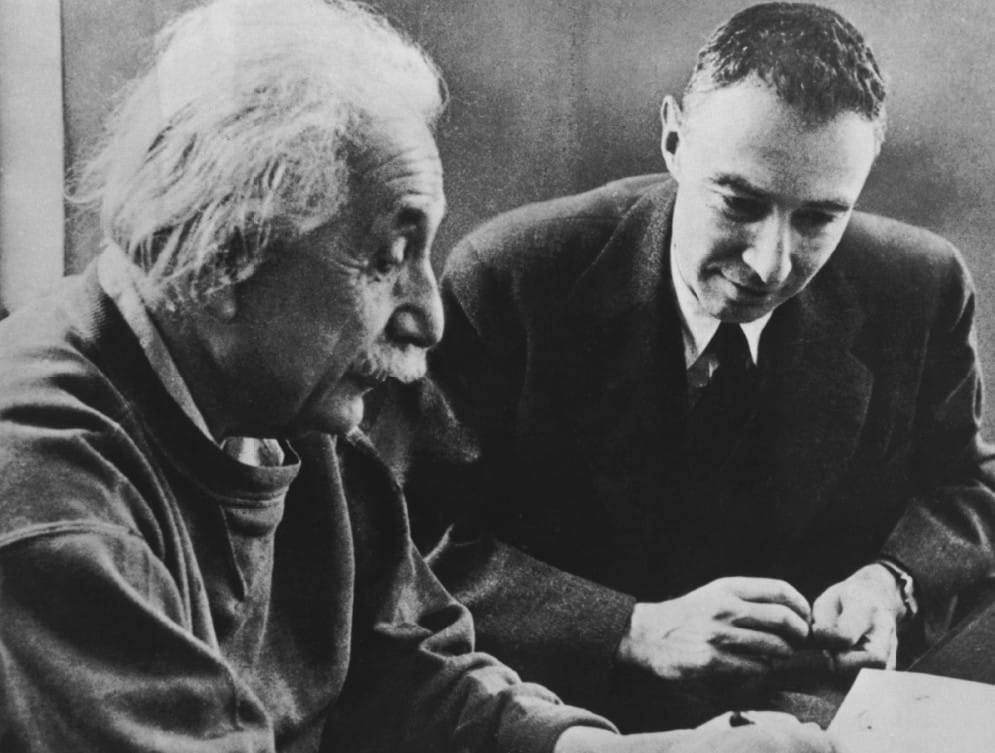
It deepens the history we think we know
Most of us got the two-paragraph textbook version of the atomic bomb; this book turns those paragraphs into an entire moral landscape. You see how scientific choices, political paranoia, and personal grudges combine to shape the world we’re still living in.
It’s a heavyweight, award-winning biography that earns the hype
American Prometheus picked up major prizes, including the Pulitzer and the National Book Critics Circle Award, and is widely considered the definitive Oppenheimer biography. For readers who like to tackle “the” book on a subject, this is the one to have under their belt.
The film Oppenheimer is epic. Here is why you should watch or rewatch it.
You’re watching a modern classic in real time
This isn’t just hype: Oppenheimer won 7 Oscars, including Best Picture, Best Director for Christopher Nolan, Best Actor for Cillian Murphy, and Best Supporting Actor for Robert Downey Jr., plus awards for cinematography, editing, and original score. It’s one of those films we’ll be talking about the way earlier generations talked about Lawrence of Arabia or The Godfather.
It’s catnip for history-loving readers
If you’ve ever fallen down a rabbit hole about World War II, the Manhattan Project, or the ethics of science, this film lands right in your wheelhouse. It traces J. Robert Oppenheimer from his early academic life to his role directing Los Alamos and overseeing the first atomic bomb test, all the way through the political fallout that followed.
The Trinity test sequence is pure cinematic awe
The build-up to the first atomic bomb detonation at the Trinity site in New Mexico is as tense as any thriller, even though you know exactly how it ends. Nolan stages the countdown, the silence, and the sound in a way that lets you feel both the scientific triumph and the dread baked into that moment.
The performances are a book-club discussion all by themselves
Cillian Murphy doesn’t just play Oppenheimer; he inhabits the man’s brilliance, vanity, guilt, and self-destructiveness so fully that you can almost imagine annotating his expressions. Around him, Emily Blunt, Robert Downey Jr., and an absurdly stacked supporting cast turn even short scenes into little character studies ripe for conversation.
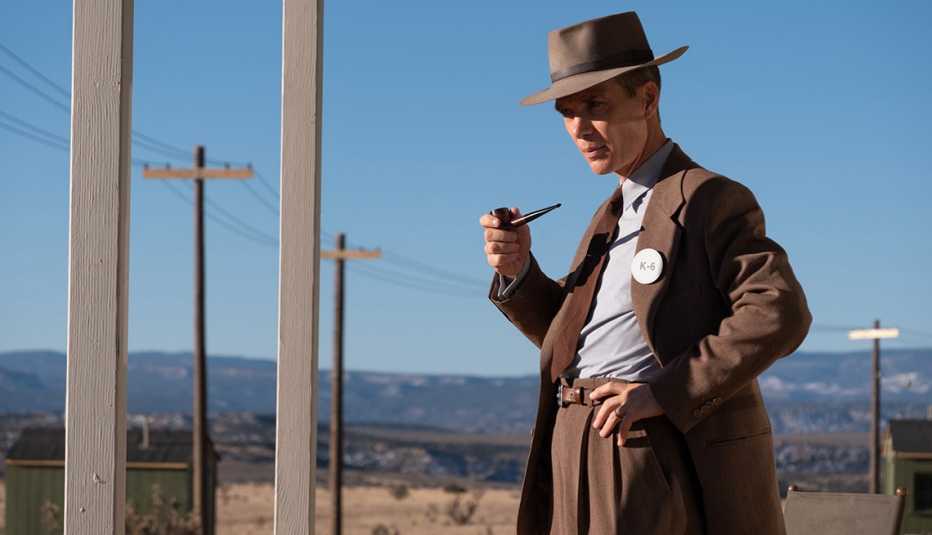
It’s a three-hour character study disguised as a blockbuster
Yes, there are explosions, but the real fireworks are verbal: hearings, interrogations, moral arguments, and betrayals. For readers used to sinking into a long, layered novel, the shifting timelines and point-of-view “chapters” feel like turning pages rather than “enduring” a long movie.
The ethical questions linger like a haunting ending
The film leans hard into the question, “What do we owe the world once we’ve created something we can’t take back?” You get scientific ambition, political pressure, and personal responsibility colliding in ways that would make an incredible book club meeting all on their own.
It’s gorgeous to look at, even when it’s horrifying
Shot in large-format IMAX with meticulous attention to light and texture, Oppenheimer turns labs, deserts, and hearing rooms into stark, memorable images. Even if you normally come for the story first, the visuals and editing make the film feel like a carefully designed “page layout” for the screen.
The score deserves its own appreciation watch
Ludwig Göransson’s original score—yes, the one that also took home an Oscar—does a lot of heavy lifting with tension, dread, and those racing, ticking motifs. On a rewatch, it’s fun to focus less on the plot and more on how the music cues your emotions before the characters say a word.
It’s a rare grown-up hit in a superhero era
Oppenheimer became the highest-grossing World War II movie in history and crossed roughly $950 million worldwide, all without capes, quips, or CGI armies. For readers who complain “they don’t make adult movies anymore,” this is Exhibit Audiences will show up for complex, talky dramas.
It’s a timely conversation about power and technology
Although it’s set in the 1940s and 1950s, the film speaks directly to modern anxieties about inventions that outpace our ability to control them. It’s a surprisingly relevant double feature with our current worries about everything from AI to climate tech and beyond.
The 98th Academy Awards (2026 Oscars) will air live on Sunday, March 15, 2026, at 7 p.m. ET (4 p.m. PT). The ceremony will be broadcast from the Dolby Theatre in Hollywood on ABC and available to stream on Hulu. Comedian Conan O'Brien is set to host the event.
Comments