
Table of Contents
- Date Published:
2025 - Length:
336 pages—Listening Time: 8 hours 38 minutes - Genre:
Fiction - Setting:
2023 with flashbacks that span six decades, Beruit, Lebanon and a writing residency in Virginia, USA - Awards
National Book Award Winner Fiction 2025; Aspen Words Literary Prize Shortlist 2026;
NPR: Books We Love 2025; Globe and Mail Top 100 Book International Fiction 2025; The Guardian Book of the Day 02-12-2026; Chicago Public Library Best of the Best: Adults Fiction 2025; Time Magazine's Must Read Books of the Year Fiction 2025; New Yorker Best Books of the Year 2025 - Languages:
English - Sensitive Aspects:
War and civil conflict, terrorism and military violence, kidnapping and prolonged captivity of a teen, psychological abuse and Stockholm syndrome dynamics, queerphobia and anti-gay discrimination, gender-based bullying and harassment, toxic patriarchal family dynamics, depictions of economic collapse and poverty, depictions of large-scale explosions and disaster (Beirut port blast), pandemic illness and mass death, PTSD, suicidal ideation or despair, religious and political tension in Lebanon, graphic descriptions of fear and bodily vulnerability, homophobic slurs and bigoted language, substance use and coping through self-destructive behavior, invasive parental control and emotional enmeshment - Movie:
There are no active movie adaptations of The True True Story of Raja the Gullible (and His Mother) at this time. - Recommended for Book Club:
Yes

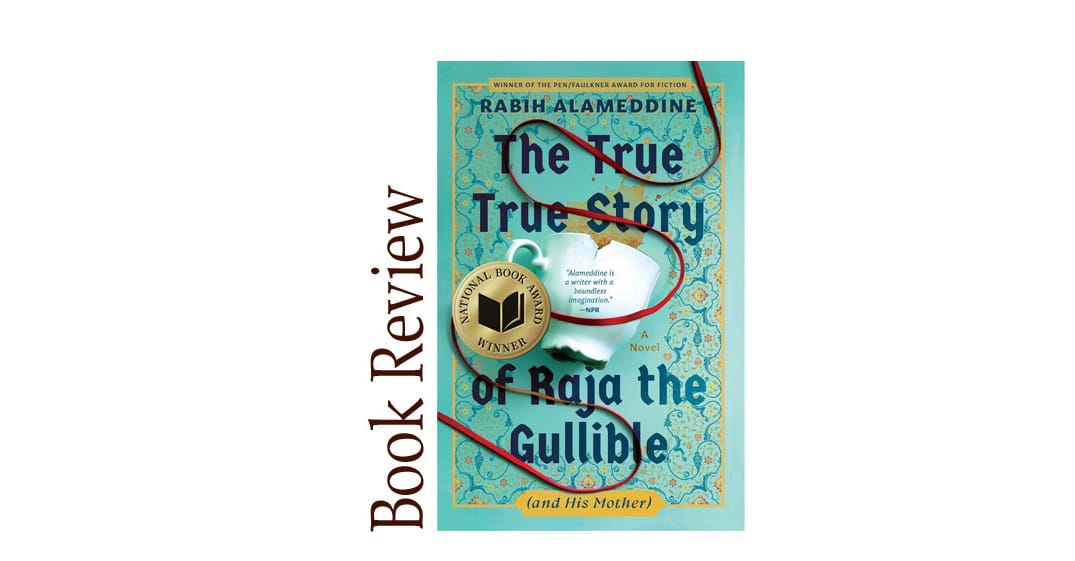
If there were ever a time to praise the audacity of humor, Rabih Alameddine's The True, True Story of Raja the Gullible earns a standing ovation. This isn’t a book that merely dips its toe into irony—it dives in headfirst, fully dressed, during a historical thunderstorm. Set against the violent, grief-soaked backdrop of Lebanon’s civil war, Raja’s tale dares to wield satire like a shield and turns human foolishness into a form of fragile grace. I laughed, I winced, and more than once, I found myself marveling at how laughter could coexist with devastation. That delicate, tongue-in-cheek balance is exactly what makes this novel magnetic—and why I happily stamped it with nine shining stars.
What’s extraordinary is how the author never lets the humor slip into cruelty. Instead, it winks at tragedy, as if to say: “Look, even amid the rubble, the heart insists on being absurd.” Raja is not your typical war-story protagonist. He’s naïve, hopeful, and occasionally ridiculous—an almost childlike mirror reflecting the absurdities of an adult, collapsing world. And yet, through that very gullibility, he becomes the bravest of all—willing to believe, to trust, to keep reaching for light when cynicism is the safer choice.
The language brims with irony and charm; it disarms you right when you think the narrative will turn bleak. Like a Lebanese Scheherazade, the storyteller flirts with despair but never gives in to it. That’s where the book’s true genius lies—not in the war scenes, but in its stubborn insistence on humor as survival. By the final page, Raja may still be gullible, but so are we, the readers—gullible enough to believe that wit and tenderness might still make sense of a senseless world.

The True, True Story of Raja the Gullible (and His Mother) opens in 2023 in a small Beirut apartment, where sixty-three-year-old Raja—a beloved high school philosophy teacher and, as he cheerfully describes himself, "the neighborhood homosexual"—lives with his octogenarian mother, Zalfa. Raja relishes books, solitude, and order. Zalfa relishes knowing every detail of his life and overriding his preferences at every turn. Their warm, bickering dynamic sets the comic tone for everything that follows.
From this cozy domestic present, the novel spirals backward and forward across six decades of Lebanese history, touching the Civil War, Israeli shelling, the 2019 banking crisis, the Beirut Port Explosion, and the COVID-19 pandemic. The emotional centerpiece of the novel is Raja's kidnapping at roughly age fifteen or sixteen by Boodie, a slightly older schoolmate, during the 1975 Civil War. Over two months of captivity, Raja experiences what he later calls both "horrifying" and "exhilarating"—danger and desire, helplessness and discovery, tangled together in ways the novel refuses to simplify. Boodie becomes captor, confessor, and abuser all at once, and Raja's complicated feelings about that time shadow the rest of his life.
The novel also charts Zalfa's formidable resilience: during the 2019 banking collapse, when Lebanon's corruption swallowed everyone's savings, Raja quietly accepts his losses—while Zalfa marches into her bank, negotiates her way to a withdrawal, and promptly joins the anti-government protest movement. When COVID arrives, she befriends a local gangster named Madame Taweel during their neighborhood walks. Years later, after the Port Explosion destroys the home of Raja's loathed aunt Yasmine and cousin Nahed, they move in uninvited—and Raja discovers, to his astonishment, that shared grief reshapes old resentments.
The novel's late chapters bring Boodie back into the picture when Raja accepts an invitation to an exclusive writers' retreat in the United States, only to discover that Boodie—now older and living abroad—runs the organization. Raja, who has finally named what happened to him as abuse, confronts Boodie, who insists he never stopped loving Raja. Raja enlists Madame Taweel's help to get home immediately. It is a scene both absurd and quietly devastating—and it's a perfect example of how the humor in Raja's retelling carries the entire book. He weaponizes wit against trauma, turning every humiliation into a story worth laughing at, even when the laughter catches in your throat.

Why Readers with Wrinkles Will Love The True, True Story of Raja the Gullible:
Because stories still save us.
Alameddine reminds us that the act of telling and retelling—whether truthful or embroidered—is how we stay connected to the world, especially when time starts to blur the edges of memory.
Because it laughs at our seriousness.
Raja’s gullibility isn’t a flaw but a mirror: it reflects how all of us, at some point, have believed in love, art, or purpose with naïve devotion. There’s comfort in that shared foolishness.
Because aging doesn’t mean cynicism.
Alameddine’s storytelling celebrates curiosity at any age. For readers who’ve lived long enough to be both wise and wistful, Raja’s openness feels like rebellion against the jadedness of modern life.
Because it’s a love letter to readers who’ve lived many lives through books.
Every page hums with literary echoes—Scheherazade, Cervantes, even Alameddine’s own past work—creating a conversation that seasoned readers will recognize and savor.
Because it asks the oldest question there is. What’s true, really?
Alameddine doesn’t give easy answers, but for those who’ve lived long enough to see truths bend with time, his ambiguity feels beautifully honest.
Because humor can be holy.
Beneath the satire, there’s deep tenderness. Alameddine’s wit sharpens the pain but never dulls the empathy—something readers with a few wrinkles will instantly recognize as life itself.

Get Rabih Alameddine Books
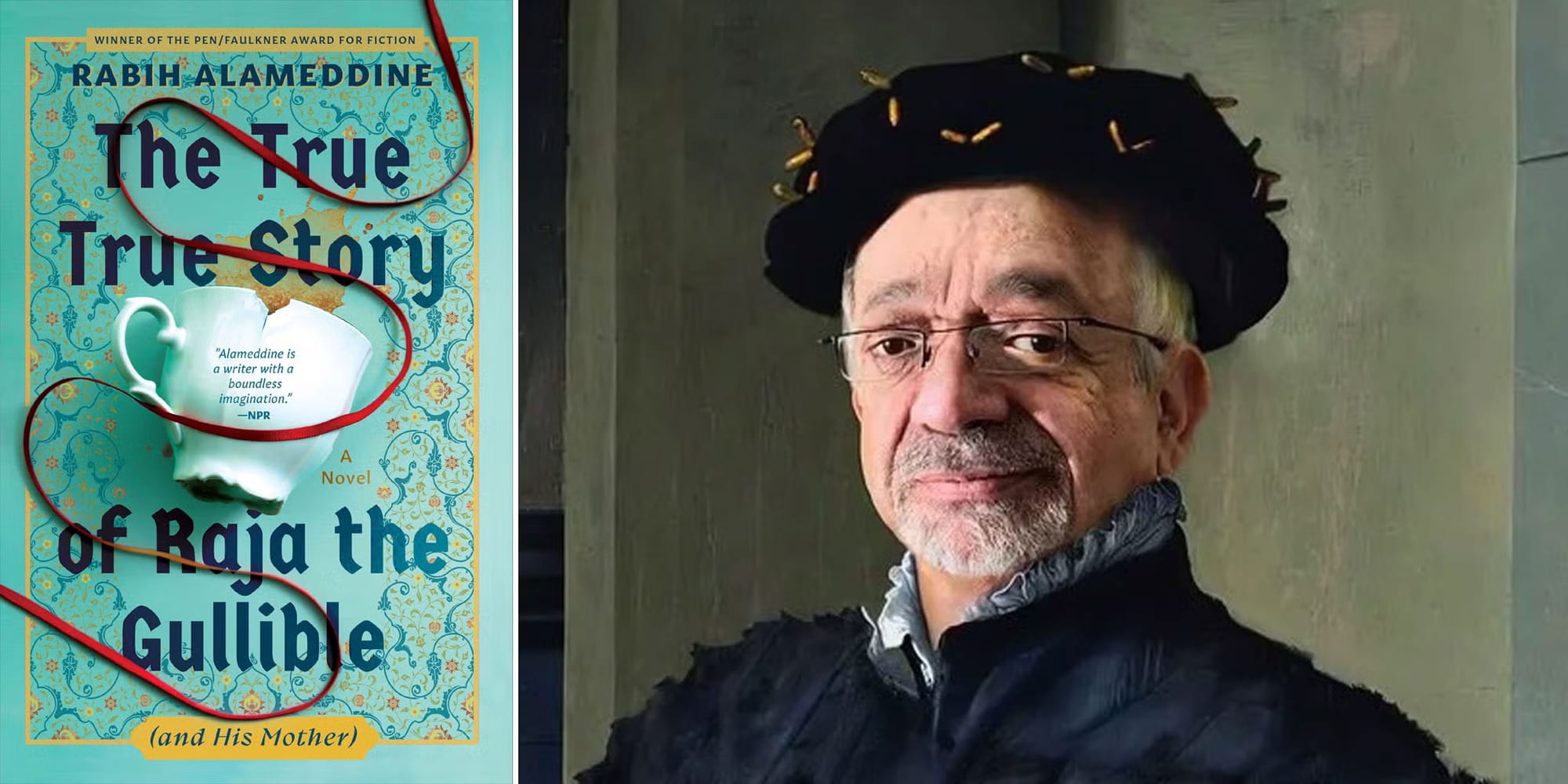
Rabih Alameddine — winner of the 2025 National Book Award and the PEN/Faulkner Award — weaves together the turbulent histories of Lebanon, the Arab diaspora, and the LGBTQ+ experience into boldly inventive, darkly humorous novels that explore identity, memory, grief, and the redemptive power of storytelling
Bookshop.org was created as a socially conscious alternative to Amazon, with the goal of helping local, independent bookstores thrive. This is why Readers With Wrinkles supports their efforts. Please join us in this effort by purchasing your next read here.

Here is a curated list of books that share key qualities with The True True Story of Raja the Gullible (and His Mother) — dark humor, queer identity, family bonds, Middle Eastern settings, literary depth, nonlinear storytelling, and navigating personal and political trauma.
- An Unnecessary Woman by Rabih Alameddine
The most natural companion read — also by Alameddine and set in Beirut. It follows Aaliya, an aging, reclusive woman who has spent decades secretly translating literary masterworks into Arabic, using books as her armor against loneliness and the chaos of Lebanon around her. Fans of Raja's literary wit and Beirut backdrop will feel immediately at home. - The Hakawati by Rabih Alameddine
Another Alameddine novel, The Hakawati (meaning "the storyteller" in Arabic) weaves together Lebanese family history with ancient myths and fables. Like Raja, it uses a nonlinear structure and nested storytelling to illuminate a life through memory, tradition, and the power of narrative itself. - The Emperor of Gladness by Ocean Vuong
Goodreads readers specifically cited this as having "similar vibes" to Raja the Gullible. A 19-year-old Vietnamese American man on the brink of suicide forms an unexpected bond with an elderly woman with dementia, creating a chosen family in a decaying Connecticut town. It shares Raja's themes of isolation, caretaking, queer identity, and tender humor in the face of hardship. - Martyr! by Kaveh Akbar
A young, queer Iranian American navigates grief, addiction, and identity in the American Midwest. Like Raja, it's been praised for being "actually funny" in a Vonnegut-style absurdist way, while simultaneously confronting deep personal and cultural loss. - Greta & Valdin by Rebecca K. Reilly
A sparkling novel about two queer, neurodivergent siblings in New Zealand — part of a wonderfully eccentric multiracial family — navigating heartbreak and self-discovery. It shares Raja's hallmark blend of sharp humor, warm family chaos, and literary intelligence. - 10 Minutes 38 Seconds in This Strange World by Elif Shafak
Set in Istanbul, this novel explores the life of a murdered woman through her final memories, tracing friendships forged on the margins of society. Like Raja, it uses a non-chronological structure to illuminate a life of outsiderness — in a Muslim-majority country, through dark humor and compassion. - The Map of Salt and Stars by Zeyn Joukhadar
Two parallel narratives follow young girls displaced by war in Syria, separated by centuries but linked by resilience and longing. The Middle Eastern setting, the weight of conflict, and the deeply personal perspective echo Raja's portrait of Lebanon's traumas. - Reading Lolita in Tehran by Azar Nafisi
A memoir-novel hybrid about a group of women in Iran who secretly gather to read banned Western literature. Like Raja, it explores how books, identity, and intellectual life become acts of defiance and survival under political instability.
Comments