

In this kit:
- Book Summary Page (Online & Printable Kit)
- Main Characters Page (Online & Printable Kit)
- Discussion Questions Page (Online & Printable Kit)
- Book Quotes Page (Online & Printable Kit)
- Icebreaker Games (Printable Kit only)
- About the Author Page (Online & Printable Kit)
- Historic Facts Surrounding the Book (Online & Printable Kit)
- List of Podcasts and Videos About This Book (Online only)
- Meeting Decoration Ideas (Online & Printable Kit)
- Meeting Decorations Printable Images (Printable Kit only)
- Meeting Menu Ideas (Online & Printable Kit)
- Email Templates for Announcing the Book Club Meeting (Printable Kit only)
- Meeting Food Recipes (Printable Kit only)
- Bookmarks for Partita (Printable Kit only)
- Bookmarks for Readers With Wrinkles (Printable Kit only)

The purpose of this summary is to refresh the memories of readers who have already read Partita regarding the plot events of the book. There are spoilers included in this summary.
Partita (Harper, October 6, 2026) is Barbara Kingsolver’s first novel since her Pulitzer Prize–winning Demon Copperhead, and the October 2026 Read with Jenna pick. A partita is a musical suite made of contrasting movements, and Kingsolver builds the novel the same way: chapters titled Overture, Prelude, Toccata, Allemande, Sarabande, Fugue and more move back and forth between Livia’s present-day life in Tennessee and the year 1989, when everything she had planned came apart.
Livia Cable is a piano teacher in the farm country of rural Tennessee, where she grew up. She is married to Charlie, a kind, steady dairy farmer who was once her childhood neighbor, and she spends her days teaching lessons to local children and adults. Her life is quiet, and she has made her peace with it. The novel opens with the question that has followed her since she was eleven years old: how could her beloved older brother, Cyrus, step in front of a train?
One evening, while she is frying apples for supper, Livia’s phone rings. It is Sigurd, the man she loved and lost when she was a twenty-year-old music student, calling after more than twenty years of silence. He is ill, he is coming to Nashville to see doctors, and he wants to visit her. Shaken, Livia asks for time to think. He agrees to call back in a week. The seven days that follow, each one a chapter called “Prelude,” form the present-day spine of the novel.
That same week Livia is clearing out the house of her mother, who died over the summer. Her mother was harsh and abusive, and in her later years a compulsive hoarder, and the farmhouse is packed to the ceiling with trash bags, newspapers, records, sewing patterns, and duplicates of every gift she was ever given. Livia works through the mess before dawn and between lessons, sometimes helped by her sister-in-law and best friend, Mickie, and by Charlie.
Between the Preludes, Livia remembers 1989. A farm girl with perfect pitch, she had escaped her mother on a piano scholarship to the Indiana University School of Music in Bloomington. She felt out of place among wealthier students, hid her country accent, and worked harder than anyone. She was living with Jon Link, a gentle fellow musician from Boston who talked of marriage, when she noticed a handsome man in a red shirt selling socialist newspapers outside the music building. He was Sigurd, a typesetter and labor organizer about ten years older than she was, and a member of a small revolutionary party. Their first lunch turned into a walk through a cemetery and a first kiss, and Livia fell completely in love.
That spring she set herself the hardest challenge she could find: Maurice Ravel’s Gaspard de la nuit, one of the most difficult works ever written for piano. She played it brilliantly for her faculty jury, let Jon Link leave for a summer in Munich without a proper goodbye, and moved in with Sigurd. The summer was a blur of passion, but cracks showed. Sigurd saw classical music as something for the privileged and her devotion to it as less important than the revolution. Livia, raised on a farm, could not accept his views of land and work.
At the end of the summer, Sigurd’s party ordered its members into industrial jobs, and he was sent to Arizona to organize railroad workers. After bitter arguments, Livia refused to follow, and he left. Heartbroken and short of rent money, she took a kitchen job at Gorgo’s, a diner run by Amadeo, an Italian immigrant cook who had always championed her music. One night, while cleaning a commercial dough roller, her right hand was crushed. Amadeo made sure a top surgeon saved the hand, but her concert career was over. Weeks later, routine tests revealed that she was months pregnant with Sigurd’s child. Her attempts to end the pregnancy were blocked at every turn, and when she finally reached Sigurd by phone, he offered only bus fare to come to him. She told him she never wanted to hear from him again, and never told him about her hand. Days later she nearly bled to death from a placental abruption and survived only through an emergency hysterectomy. Penniless and alone, she called home.
Charlie Cable drove to Bloomington and carried her home to Tennessee, where she learned that her father was dying of cancer. She healed while he died. He left her the dairy farm, Charlie helped her run it, and over time a deep, quiet love grew between them. They married at the courthouse. Livia slowly returned to the piano, accepting that she would never again play Gaspard de la nuit, and built a life teaching music to her neighbors, some of whom pay for lessons with eggs and butter.
In the present, the house begins to give up its secrets. Livia discovers that her mother kept every one of her recital programs, and then that her mother had once been a singer who tried her luck in Nashville before her own mother’s cruel letters pulled her home. Most devastating of all, Livia finds two suicide notes from Cyrus, one of them addressed to her, which her mother had hidden for decades. In it, Cyrus explains that he was in love with a boy, Marshall Stilwell, who was sent away to the Marines when their relationship was discovered, and he urges his little sister to hold on to her music. For the first time, Livia understands that his death was not her fault.
When Sigurd calls back, Livia finally tells him everything: the hand, the pregnancy, the hysterectomy. He is shaken, and she agrees to let him come. On Sunday she builds a bonfire outside her mother’s house with Charlie at her side, burning the hoard, the old programs and Cyrus’s letters, but saving the dresses her mother wore in Nashville. An ember catches the porch roof, and the neighbors rush to help put out the fire. That night Livia and Charlie talk openly at last.
On Monday, Livia meets Sigurd on her own terms: at a recital by her students in the little Methodist church where she first learned to play. Sigurd is older and worn by his own disappointments. Livia sits between the two men she has loved as her students play everything from simple pieces to country songs and a jazz version of Bach. Then her star pupil, Deronne, plays “Le Gibet” from Gaspard de la nuit, the music Livia once played for Sigurd. He does not recognize it. In that moment the past loses its hold. Livia takes Charlie’s hand and understands that the broken parts of her life have added up to something whole.

A quick guide to “who is who” in Partita, grouped by where they appear in Livia’s story.
♪ Livia and the Men She Loved
Livia Bohusz Cable
The narrator. A gifted pianist with perfect pitch who escaped a hard childhood on a music scholarship to Indiana University in 1989. A crushed right hand ended her concert career, and today she teaches piano and co-owns a dairy farm in rural Tennessee with her husband. Sigurd nicknamed her “Planets.”
Sigurd
Livia’s great college passion. A charismatic typesetter and union organizer about ten years her senior, devoted to his socialist party. He left for Arizona and then Los Angeles on party orders. Decades later, facing a serious illness, he calls and asks to see her.
Charlie Cable
Livia’s husband and her childhood neighbor. A quiet, practical dairy farmer who is good with animals and machines and walks with a prosthetic after a childhood mower accident. He brought Livia home from Indiana when she had nowhere else to go.
♪ The Bohusz Family
Cyrus “Cy” Bohusz
Livia’s gentle older brother, who shielded her from their mother and secretly learned piano with her. He died by suicide at seventeen, stepping in front of a train, when Livia was eleven. His hidden letter finally explains why.
Livia’s Mother
Bitter, abusive and secretive, she scorned Livia’s musical ambitions and filled the family farmhouse with a lifetime of hoarded things. She died the summer before the story begins, leaving clues to a musical past of her own.
Willard Bohusz
Livia’s father, a hardworking dairy farmer who named his barn CyLee Dairy after his two children. He died of cancer soon after Livia came home, leaving her the farm.
Marshall Stilwell
The boy Cyrus loved, who was sent away to the Marines. Livia learns about him only from her brother’s hidden letter.
♪ Family and Friends in Tennessee
Mickie Barnes
Charlie’s sister and Livia’s closest friend, a warm and outspoken high school AP English teacher. She pushes Livia to read the letters her mother left behind.
Faye and Teddy Cable
Charlie and Mickie’s parents. Faye nursed Livia and her dying father and gave Livia the mothering she never had.
Deronne
Livia’s most talented student, who surprises everyone at the final recital.
Gaz
Livia’s devoted border collie, short for Gaspard and named after Ravel’s Gaspard de la nuit. He goes everywhere with her, although he hates her mother’s house.
♪ Bloomington, 1989
Jon Link
Livia’s college boyfriend and roommate, a kind fellow musician from a well-to-do Boston family who talked of marriage before leaving for a summer in Munich.
Amadeo
The Italian immigrant cook who runs Gorgo’s diner in Bloomington and treats Livia like family. After her accident he makes sure a leading hand surgeon saves her hand. She still sends him a Christmas card every year.
Bassoon and Percussion
Jon Link’s musician friends, known by their instruments. Bassoon (Greg) becomes Livia’s loyal caregiver after her injury.
Ladawna
The warm, no-nonsense physician’s assistant who cares for Livia after her surgery and fights the hospital on her behalf.
Dr. Betis
Livia’s exacting piano professor, who doubts her and then praises her performance of Gaspard de la nuit.

Pulitzer Prize Winner, Pianist, and Voice of Appalachia
Barbara Kingsolver is one of America’s most beloved novelists. She was born on April 8, 1955, in Annapolis, Maryland, and grew up in rural Carlisle, Kentucky, with part of her childhood spent in Africa, where her parents worked in public health. Piano carried her through a difficult adolescence and won her a music scholarship to DePauw University in Indiana. She soon decided that a concert pianist’s life was too narrow for her, switched to biology, and later earned a graduate degree in ecology and evolutionary biology from the University of Arizona.
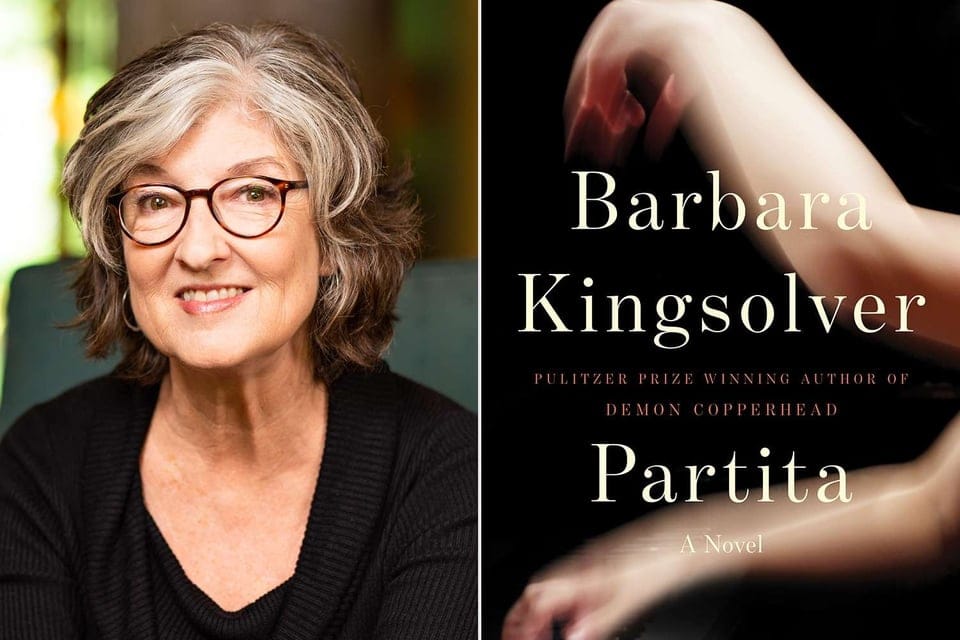
She began as a science writer and journalist in Tucson. Her first nonfiction book, Holding the Line (1989), documented the women of the 1983 Arizona copper mine strike, and her debut novel, The Bean Trees (1988), launched a fiction career that now spans Animal Dreams, Pigs in Heaven, The Poisonwood Bible, Prodigal Summer, The Lacuna, Flight Behavior, Unsheltered, Demon Copperhead and Partita. She has also published essays, poetry, the bestselling food memoir Animal, Vegetable, Miracle (written with her husband, Steven Hopp, and daughter Camille Kingsolver), and the children’s book Coyote’s Wild Home (2023), written with her daughter Lily.
Since 2004 she and her husband have farmed in southwestern Virginia, in the Appalachian mountains she considers home. She still plays piano, although she lives with Dupuytren’s contracture, an inherited condition that pulls the fingers toward the palm and requires surgery every few years. Her hand surgeon is thanked in the acknowledgements of Partita, and the experience of a “career-limiting” injury fed directly into Livia’s story.
♪ Awards and Honors
- ♪ Pulitzer Prize for Fiction (2023) for Demon Copperhead, shared with Hernan Diaz’s Trust, the first time two novels have shared the prize
- ♪ Women’s Prize for Fiction, twice: for The Lacuna (2010, then the Orange Prize) and Demon Copperhead (2023). She is the first author ever to win it twice
- ♪ National Humanities Medal (2000)
- ♪ Medal for Distinguished Contribution to American Letters from the National Book Foundation (2024)
- ♪ The Poisonwood Bible (1998): a Pulitzer Prize finalist and an Oprah’s Book Club pick. Demon Copperhead was an Oprah’s Book Club pick too, and Partita is a Read with Jenna pick (October 2026)
- ♪ Founder of the Bellwether Prize for socially engaged fiction (now the PEN/Bellwether Prize), which she funded herself
Of Partita she has said that she set out to write “a little love story” and found it growing into a set of nested boxes: a love story inside a bigger love story, wrapped in “that eternal longing that we have for art and beauty.”

Fifteen memorable passages to read aloud and discuss. Where no page number is given, the location tells you where the passage falls in the novel.
“How does a person step in front of a train?”
• Speaker: Livia
• Location: Overture, the novel’s first sentence
• Discussion Spark: The question that opens the book, and the one Livia has carried since she was eleven. Everything that follows is, in some way, an attempt to answer it.
“It tilts you on a slant, to walk your whole road with a question like that and no answer to balance it out.”
• Speaker: Livia
• Location: Overture, page 1
• Discussion Spark: Grief here is not a single event but a road, and an unanswered question throws off a person’s balance for life.
“A child can’t hate her mother without putting the load-bearing walls of the known world at risk. I settled for hating her shoes.”
• Speaker: Livia
• Location: Prelude I, the night of Sigurd’s call
• Discussion Spark: A wry, heartbreaking line about how children survive a cruel parent: they move the anger somewhere safer.
“His mind could no more hold thoughts of betrayal than a good strong hand can hold water. Just not built for the task.”
• Speaker: Livia, about Charlie
• Location: Prelude I
• Discussion Spark: A loving portrait of Charlie, but the hand imagery and the word “betrayal” hint at Livia’s own guilty secrets.
“How can he still be alive in the atoms of my body?”
• Speaker: Livia, after Sigurd’s phone call
• Location: The present-day Preludes
• Discussion Spark: Twenty-some years of silence, and one voice on the phone brings it all back.
“Oh, this, I thought, inhaling the scent of tobacco and moss and clean, damp granite, my body inhaling his body, believing whatever it wanted to tell me, taking in its nourishment. This is what it feels like to be happy.”
• Speaker: Livia
• Location: 1989 flashback, in the cemetery after her first lunch with Sigurd
• Discussion Spark: The intoxication of first love, written with a warning tucked inside: her body is “believing whatever it wanted to tell me.”
“All year, I’d been considering Ravel’s Gaspard de la nuit for my May recital, not because I loved it—though I did, everybody does—but because I was afraid of it. Fear is a powerful engine.”
• Speaker: Livia
• Location: 1989 flashback, spring semester
• Discussion Spark: Livia’s ambition in a nutshell. She chooses the hardest piece in the repertoire precisely because it might defeat her.
“When I told him it was a partita, I had to explain then what that is, a composition made of a lot of parts with different paces and moods. A partita will never be all happy rondos, or all andantes in a minor key. You’ll usually have a prelude, a thrilling allemande, maybe a slow, sexy sarabande—the contrast is the point. The parts are all different, and the artist’s work is to make them all add up to something that feels whole.”
• Speaker: Livia, explaining to Sigurd
• Location: 1989 flashback, early in their affair
• Discussion Spark: The key to the whole novel. Livia’s life, like the book, is made of contrasting movements that she must finally bring together.
“Music is made of tension. Little tense moments, one after another, each one a building block of tightness or unease that makes your body lean toward something, want it, even long for it, until that yearning is answered with release.”
• Speaker: Livia
• Location: 1989 flashback, the summer with Sigurd
• Discussion Spark: Livia describes music and love in the same language. Tension and release shape the book’s structure too.
“Music is your labor, not your floor manager. You’re the means of production. Without you, it doesn’t exist.”
• Speaker: Sigurd
• Location: 1989 flashback, at lunch when Livia worries about her future
• Discussion Spark: Sigurd puts his politics in musical terms. It is one of the moments when he truly sees her worth.
“It feels like there’s a rule that you have to keep doing it. Not just that you owe it to yourself, you owe it to the world. Maybe to God. As payback on the borrowed gift.”
• Speaker: Livia, on having a talent
• Location: Early in the novel
• Discussion Spark: The weight of a gift. Livia feels she owes her talent to the world, which makes losing it even harder.
“The point of art is to help you like your life better.”
• Speaker: Mickie
• Location: Prelude IV, walking with Livia
• Discussion Spark: Mickie’s simple, generous answer to the novel’s big question, and one Livia spends the rest of the book testing.
“The sadness is all in the melody line the left hand keeps bringing up from below, a slow arpeggio trying to climb up out of the dark, but after a few notes of rising, it falls back down… It’s the God’s honest truth of grief.”
• Speaker: Livia, playing Chopin’s B minor Prelude
• Location: After her father’s funeral, playing again with her injured hand
• Discussion Spark: Even played slowly and imperfectly, music still tells the truth. This is the moment Livia begins to heal.
“You want too much when you’re young, it’s just what you do.”
• Speaker: Livia, looking back
• Location: The present-day Preludes
• Discussion Spark: Middle-aged Livia’s gentle verdict on her twenty-year-old self.
“Sometimes you don’t survive whole, you just survive in part. But the grandeur of life is that attempt.”
• Speaker: Toni Morrison
• Location: The novel’s epigraph
• Discussion Spark: Kingsolver has called these “the wisest two sentences I’ve ever read about the human condition.” Maybe, she says, she wrote the whole novel to prove them.

Partita is fiction, but Livia’s story is woven from real music, real places, and real history. A little background makes the novel even richer to discuss.

♪ What Is a Partita?
A partita is a musical suite made of several contrasting movements, most of them based on Baroque dances. The most famous are Johann Sebastian Bach’s six keyboard partitas (BWV 825–830), published one at a time beginning in 1726 and gathered together in 1731 as Clavier-Übung I, the first of his works he published himself. Each one opens with an introductory movement and moves through dances such as the stately allemande, the running courante, the slow and expressive sarabande and the lively gigue.
Kingsolver borrows the form for her chapter titles. The present-day chapters are seven Preludes, one for each day Livia has to decide about Sigurd, and the 1989 chapters carry names like Toccata, Allemande, Sarabande and Fugue, chosen to match the mood of each part of her story. The novel even begins with a listening list of the music its characters play.

♪ Gaspard de la nuit: “The Most Difficult Piano Suite”
Maurice Ravel composed Gaspard de la nuit in 1908, inspired by the eerie prose poems of the French poet Aloysius Bertrand (1807–1841), published after his death in 1842. It has three movements. “Ondine” is a water nymph who tries to lure a mortal to be her husband. “Le Gibet” depicts a hanged man swinging on a gallows at sunset while a bell tolls. “Scarbo” is a mischievous goblin who darts through the night. Ravel deliberately made “Scarbo” more difficult than Balakirev’s Islamey, then considered the hardest piece in the repertoire, and pianists still rank the suite among the greatest technical challenges ever written.
In the novel, the suite becomes Livia’s personal Everest, the soundtrack of her affair with Sigurd, and the music that returns at the final recital. Livia’s dog Gaz is named for it, and the puppy Ondine for its first movement.
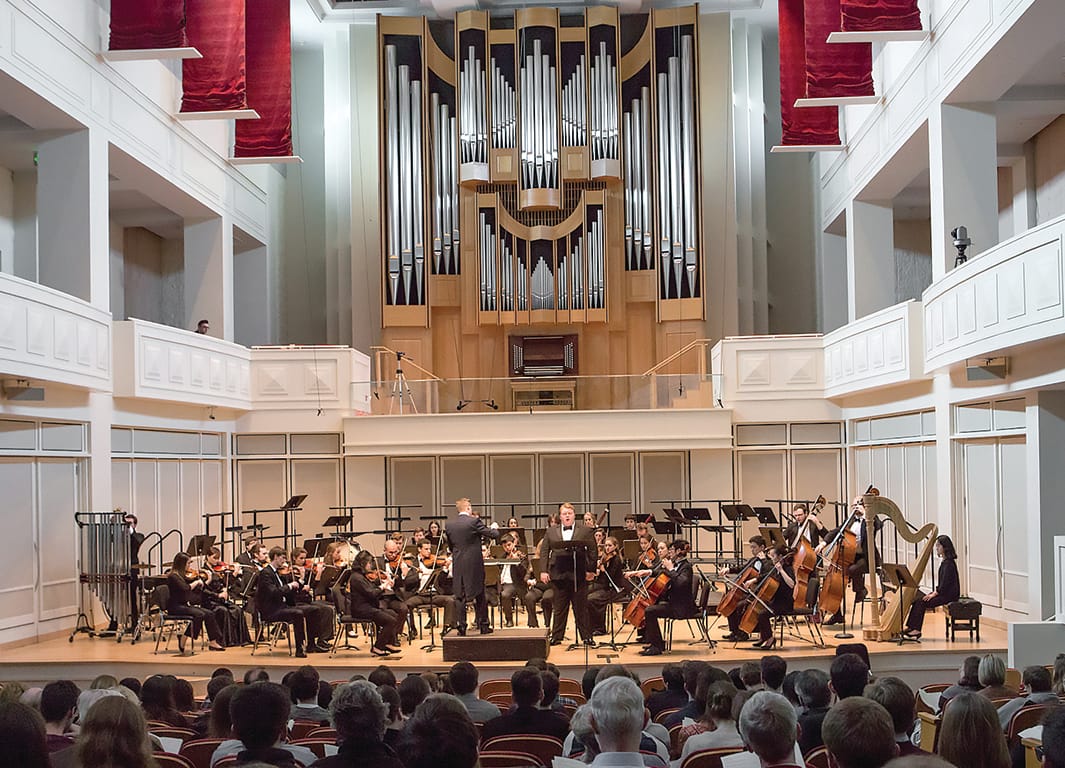
Jacobs School of Music, Indiana University
♪ Indiana University’s School of Music
Livia studies at the Indiana University School of Music in Bloomington, which became an official school in 1921 and grew into one of the largest and most respected music schools in the world. In 2005 it was renamed the Jacobs School of Music after a major gift. Kingsolver herself went to college in Indiana on a piano scholarship, at DePauw University, and like Livia she felt like a country outsider among her classmates.
♪ Campus Activism and the “Free South Africa” Movement
Livia first spots Sigurd again running the sound equipment at a Free South Africa rally. In the 1980s, students across the United States demanded that their universities divest, or sell their investments in companies doing business with apartheid South Africa. At more than 100 schools they built “shantytowns” to resemble the shacks many Black South Africans were forced to live in. At Indiana University, students began building shanties in Dunn Meadow in April 1986. Nelson Mandela was released from prison in February 1990, only months after the summer Livia remembers.
♪ The Socialist Workers Party and the “Turn to Industry”
Sigurd belongs to the Party, which several guides identify as the Socialist Workers Party, a small Trotskyist group founded in 1938 that published a weekly newspaper, The Militant, the paper Sigurd sells on campus. In 1978 the party adopted what it called the “turn to industry,” directing most of its members to leave their jobs and studies and take work in basic industries such as steel, coal, auto plants, meatpacking and the railroads, so they could organize from inside the unions. That is why Sigurd is ordered to Arizona to work on the railroad, and why he goes.
♪ 1989: A Year of Earthquakes
Livia calls 1989 a “year of earthquakes and oil spills and iron curtains starting to crash,” and she is not exaggerating. The Exxon Valdez spilled millions of gallons of oil into Alaska’s Prince William Sound in March. The Loma Prieta earthquake shook the San Francisco Bay Area in October. On November 9, the Berlin Wall fell, and communist governments across Eastern Europe toppled one after another, a backdrop that adds irony to Sigurd’s dreams of revolution.

♪ Abortion Access in the Late 1980s
Livia’s pregnancy is discovered late, and the barriers she faces were real in that era. Under Roe v. Wade, states could regulate second-trimester abortions, and Indiana required them to be performed in a hospital, which made them far more expensive. Indiana also required parental consent for patients under 18. In the novel, a protester posing as a clinic worker falsely tells twenty-year-old Livia that she needs her parents’ permission. In July 1989 the U.S. Supreme Court’s Webster v. Reproductive Health Services decision gave states more room to restrict abortion, part of the tense atmosphere of the summer in which the novel is set.
♪ Hoarding Disorder
Livia’s mother fills the family farmhouse with junk mail, records, sewing patterns and duplicates of every gift she ever received. In her youth Livia judged her mother harshly; as an adult she understands it was an illness. Hoarding was long considered a symptom of obsessive-compulsive disorder. In 2013 the American Psychiatric Association recognized hoarding disorder as a condition of its own in the DSM-5, defined by persistent difficulty parting with possessions, whatever their value, and the distress that parting causes.
♪ Small Farms and Rural Life in Tennessee
Livia’s family runs a dairy and grows tobacco, the backbone of many small Tennessee farms in the 20th century. Both have declined sharply. Tennessee had 8,206 tobacco farms in 2002 but only 241 in 2022, after the 2005 federal tobacco buyout ended the old price-support system, and the number of licensed dairies in the state fell by nearly half between 2002 and 2010. The novel also shows a quieter hardship: farm families who can afford to insure their animals but not themselves. Livia’s father cannot pay for the treatment that might have saved him, and neighbors barter eggs and butter for piano lessons.
♪ A Note on Suicide and Hope
Cyrus’s death sits at the heart of the novel. Kingsolver has said that she has lost four people close to her to suicide and did not write about it lightly. His story also reflects the isolation many gay young people faced in small rural communities in decades past. If anyone in your group is struggling, help is available: in the United States, call or text 988 to reach the Suicide & Crisis Lifeline.

Partita gives a book club plenty to talk about: first love and lasting love, family secrets, grief, class, and what art is really for. These original questions follow the novel’s movements, from the music on its pages to the secrets in Livia’s mother’s house.
Host’s note: These questions contain spoilers and are meant for discussion after everyone has finished the book. The novel deals with suicide, abuse and pregnancy loss, so choose the questions that suit your group rather than feeling obliged to cover all thirty.
♪ A Novel in Movements
- Kingsolver structures the novel like a partita, with chapters named for musical movements. Did knowing what a prelude, toccata or sarabande is change how you read those chapters? Did you listen to any of the music while reading?
- Livia says a partita has many parts with different moods and that “the artist’s work is to make them all add up to something that feels whole.” What are the “movements” of Livia’s life? Does she make them whole by the end?
- The novel opens with Toni Morrison’s words: “Sometimes you don’t survive whole, you just survive in part.” How does that epigraph frame Livia’s story? Do you agree with it?
♪ Grief and the Phone Call
- The first sentence asks how a person could step in front of a train. How does Cyrus’s death shape every other relationship in Livia’s life?
- Livia gives herself seven days to decide whether to see Sigurd. If you were her friend, what would you have told her on Monday? Would your advice have changed by Sunday?
- Livia calls Sigurd’s phone call “like a bomb” and an “earthquake I didn’t ask for.” Why does a voice from twenty-some years ago still have so much power over her?
♪ Livia and Sigurd, 1989
- What drew Livia to Sigurd so quickly? What did he offer her that Jon Link could not?
- Sigurd sees classical music as something for the privileged, and Livia sees it as hard-won labor. Who do you think is right, or are they both partly right?
- Livia chooses Ravel’s Gaspard de la nuit partly because she is afraid of it. Have you ever taken on something hard precisely because it scared you? How did it turn out?
- Livia hides her country accent at college and feels she must earn her place. How does Kingsolver show class barriers in the music world? Have you ever felt like an outsider in a place you worked hard to reach?
♪ What Is Art For?
- Mickie says, “The point of art is to help you like your life better.” Livia isn’t so sure. What do you think art is for?
- Livia once refused to let a grieving student play a country song at a formal recital, yet her final recital includes country songs, jazz and a rock song. What changed in her?
♪ Choices and Consequences
- Sigurd leaves for Arizona on his party’s orders. Was he choosing a cause over Livia, or was Livia choosing music over him?
- Livia never tells Sigurd about her hand. Why do you think she kept it from him for so long? Was it protection, pride or punishment?
- The obstacles Livia faces when she tries to end her pregnancy are a turning point in her life. How did you react to this part of the story, and why do you think Kingsolver included it?
- Charlie is described as a man whose mind “could no more hold thoughts of betrayal than a good strong hand can hold water.” Is Charlie as simple as Livia first suggests? What do we learn about his inner life?
♪ The House and Its Secrets
- Livia keeps parts of her past from Charlie and Mickie for decades. What does secrecy cost the people in this novel?
- Livia’s mother hoarded possessions, and Livia admits she has hoarded guilt and blame. What else do the characters hold on to that they should let go of?
- How did your feelings about Livia’s mother change when you learned about her singing, her time in Nashville and her own mother’s letters? Does understanding someone’s pain excuse the pain they cause?
- Charlie thinks Livia’s mother bought two of every gift because she wanted to keep the feeling of giving. Livia thinks she simply couldn’t part with anything. Whose theory do you believe?
- Cyrus’s letter reveals that he loved Marshall Stilwell. How does this discovery change Livia’s understanding of her brother, her mother and herself?
- Livia saves her mother’s Nashville dresses from the bonfire but burns almost everything else, including Cyrus’s letters. Why those choices? What would you have saved?
♪ Love, Old and New
- The book has been called a love story inside a bigger love story, wrapped in our longing for art and beauty. Which love story moved you most?
- Compare first love with Sigurd and mature love with Charlie. Is one more “real” than the other?
- Why do you think Livia chooses to meet Sigurd at her students’ recital, in the church where she first learned to play?
- Sigurd does not recognize “Le Gibet” when Deronne plays it. Why is that moment so freeing for Livia?
♪ Surviving in Parts
- Kingsolver herself studied piano on a scholarship and lives with a hand condition that limits her playing. How does knowing this affect your reading of Livia’s story?
- The novel distinguishes career-ending injuries from career-limiting ones. Have you had to accept that you can no longer do something you once did well? How did you find a new way forward?
- How does the rural community, with its potlucks, bartered lessons, borrowed backhoes and neighbors fighting a fire, compare with the world of the conservatory?
- If Partita were a piece of music, what would it sound like to you? Which character would be the melody, and which the bass line?

Hear Barbara Kingsolver talk about Partita, music and her own hands in her own words. Every link below was checked in November 2026.
♪ Podcasts
A visit with Barbara Kingsolver: We talk ‘Partita,’ piano, aging and Appalachia
NPR’s Book of the Day, with Andrew Limbong · October 2, 2026 · about 31 minutes
Recorded at her home in southwestern Virginia beside her piano. Kingsolver talks about studying classical piano, living with Dupuytren’s contracture, losing people to suicide, and why so many Americans feel the fine arts belong to “fancy people in cities.”
Listen: https://www.npr.org/2026/10/02/nx-s1-5988062/barbara-kingsolver-partita
Barbara Kingsolver on PARTITA
Poured Over (Barnes & Noble) · October 8, 2026 · about 58 minutes
A long, relaxed conversation about resilience, possibility and the transformative power of music, and about how she followed up the enormous success of Demon Copperhead.
Listen: https://podcasts.apple.com/us/podcast/barbara-kingsolver-on-partita/id1567969228?i=1000793845158
Barbara Kingsolver on Partita, First Love, and Who Gets to Make Art
For the Love with Jen Hatmaker · October 14, 2026 · about 1 hour 6 minutes
A warm, wide-ranging talk about Livia, first love and mature love, and the question at the heart of the book: who gets to make art?
Listen: https://jenhatmaker.com/podcasts/series-64/barbara-kingsolver/
♪ Videos
♪ Bonus
Barbara Kingsolver: Partita Playlist
Apple Music Classical
The music from the novel, including Ravel’s Gaspard de la nuit, Bach’s partitas, Chopin and Satie. Lovely background music for your meeting.
https://classical.music.apple.com/us/playlist/pl.780ee0e741bd4ed0b5ad51a24a75cac7
Partita by Barbara Kingsolver – the music of a life
Milly’s Book Shelf (YouTube review, about 6 minutes)
A thoughtful reader’s review of the novel.
https://www.youtube.com/watch?v=8HzQCj1BUSw

Partita moves between a Tennessee dairy farm and a 1989 conservatory, and it is full of music from its first page to its final recital. These ideas bring both worlds to your table: sheet music and candlelight, mason jars and hay, and a little midnight blue for Gaspard de la nuit.
The Recital Program
Print your meeting agenda as a recital program, just like the ones Livia’s mother secretly saved. List the evening as movements: Overture (welcome), Prelude (icebreaker), Sarabande (discussion), Gigue (dessert) and Al Fine (goodbyes). Set one at every place.
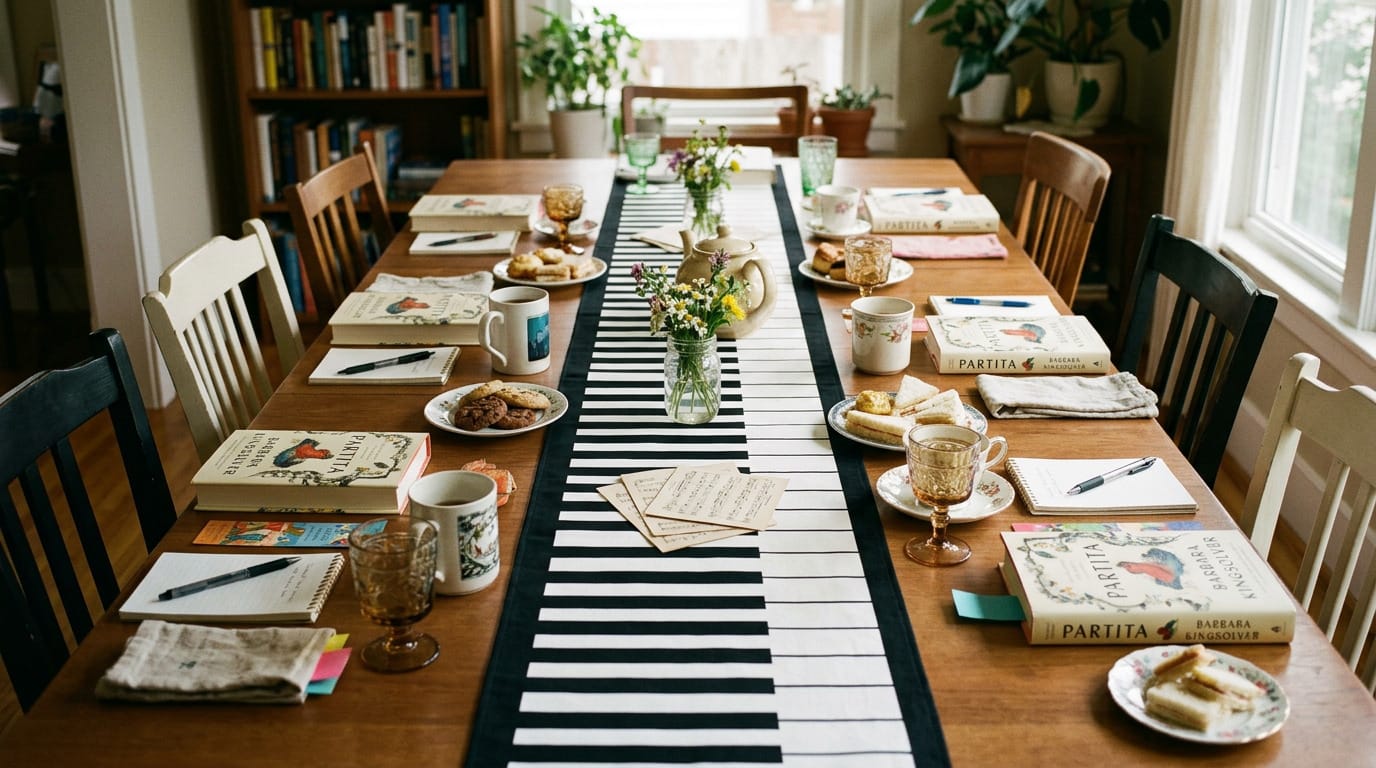
Piano-Key Table Runner
Run a black-and-white piano-keyboard runner down the center of the table. Buy one ready-made, or make your own with a strip of white paper and black construction-paper keys.
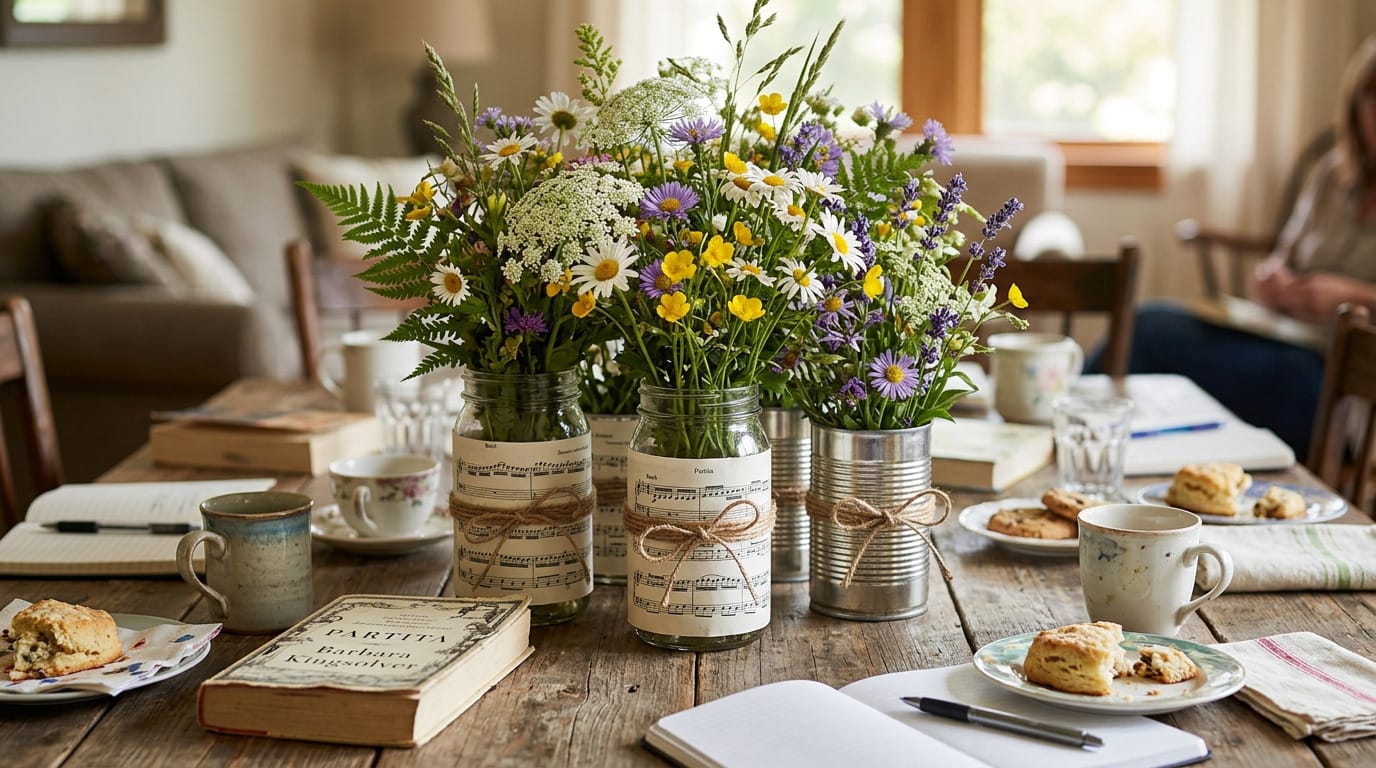
Sheet-Music Vases
Wrap mason jars or tin cans in photocopied sheet music, tie with twine, and fill with wildflowers. Look for free printable pages of Bach’s partitas or Chopin’s preludes, two composers Livia loves.
Midnight Blue for Gaspard de la Nuit
Gaspard de la nuit means “Gaspard of the night.” Use a midnight-blue tablecloth, silver candlesticks and a scattering of star and moon confetti for an elegant evening mood.
Ondine’s Floating Candles
For “Ondine,” the water nymph of Ravel’s first movement, fill a wide glass bowl with water, a few drops of blue food coloring and floating candles. Add a sprig of greenery or a few white petals.
CyLee Dairy Milk Bottles
Honor Livia’s father and the barn he named for his children. Use glass milk bottles as bud vases, or tie a little kraft tag reading “CyLee Dairy” around each one.
Farm-Country Centerpiece
Bring the hayfields indoors with a small hay bale or a basket of straw, a galvanized bucket of sunflowers, and a few brown eggs in a wire basket. A reminder of the neighbors who pay for piano lessons with eggs and butter.
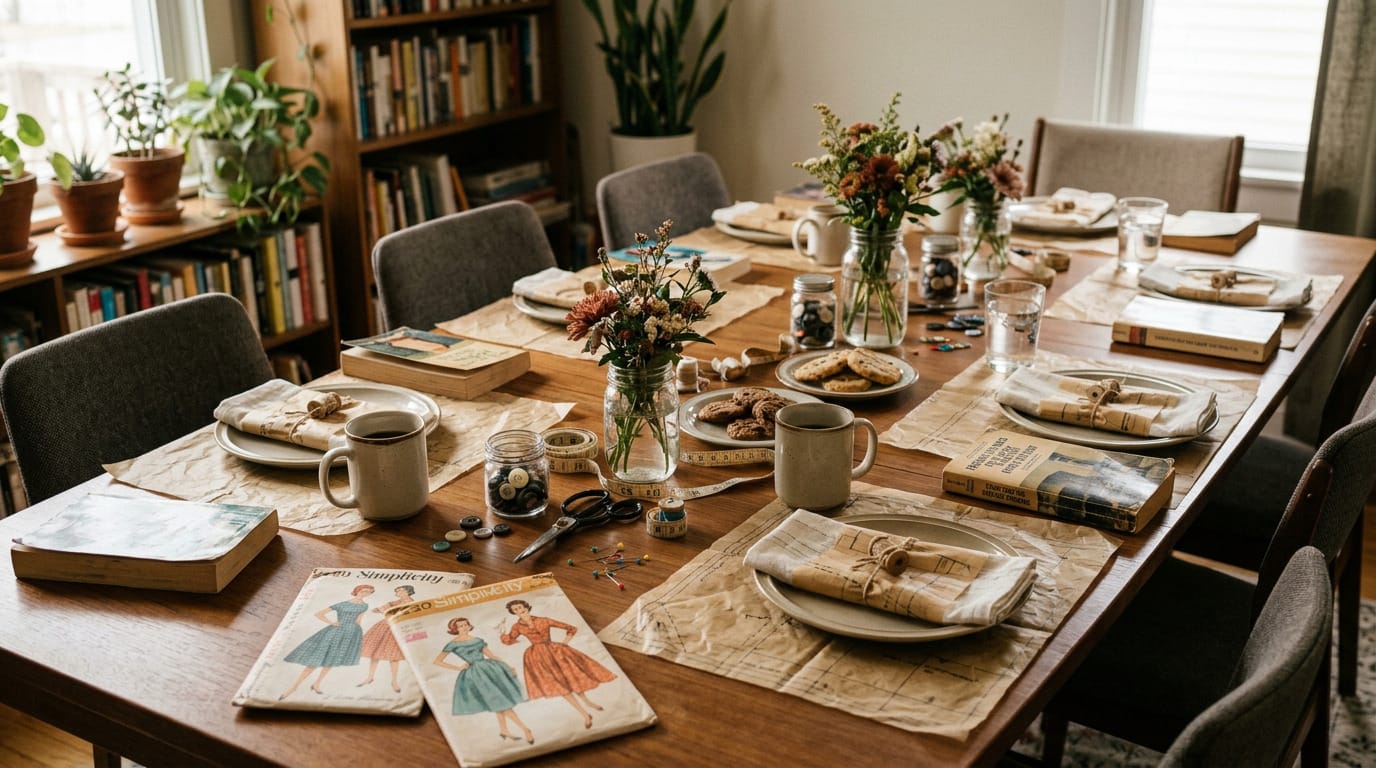
Mom’s Sewing Patterns
Livia finds stacks of old dressmaking patterns in her mother’s house. Scatter vintage pattern envelopes on the table, or use pattern tissue as placemats or napkin wraps.
Vinyl Record Chargers
Use old vinyl records as chargers under your plates, or hang a few on the wall. Her mother bought records she never let anyone hear, and Cyrus got in trouble for touching them.
A Nashville Dress
Hang a vintage dress on a padded hanger near the entrance in honor of the dresses Livia saves from the bonfire. Pin on a card: “Saved from the fire.”
The Church Piano Corner
If you have a piano or keyboard, make it a focal point with a candle, an open hymnal and a small vase of flowers. No piano? Prop up a framed photo of an old upright from a little country church.
Planets String Lights
Sigurd calls Livia “Planets.” Drape warm string lights overhead or tuck in a few small paper globes or planet ornaments among the centerpieces.
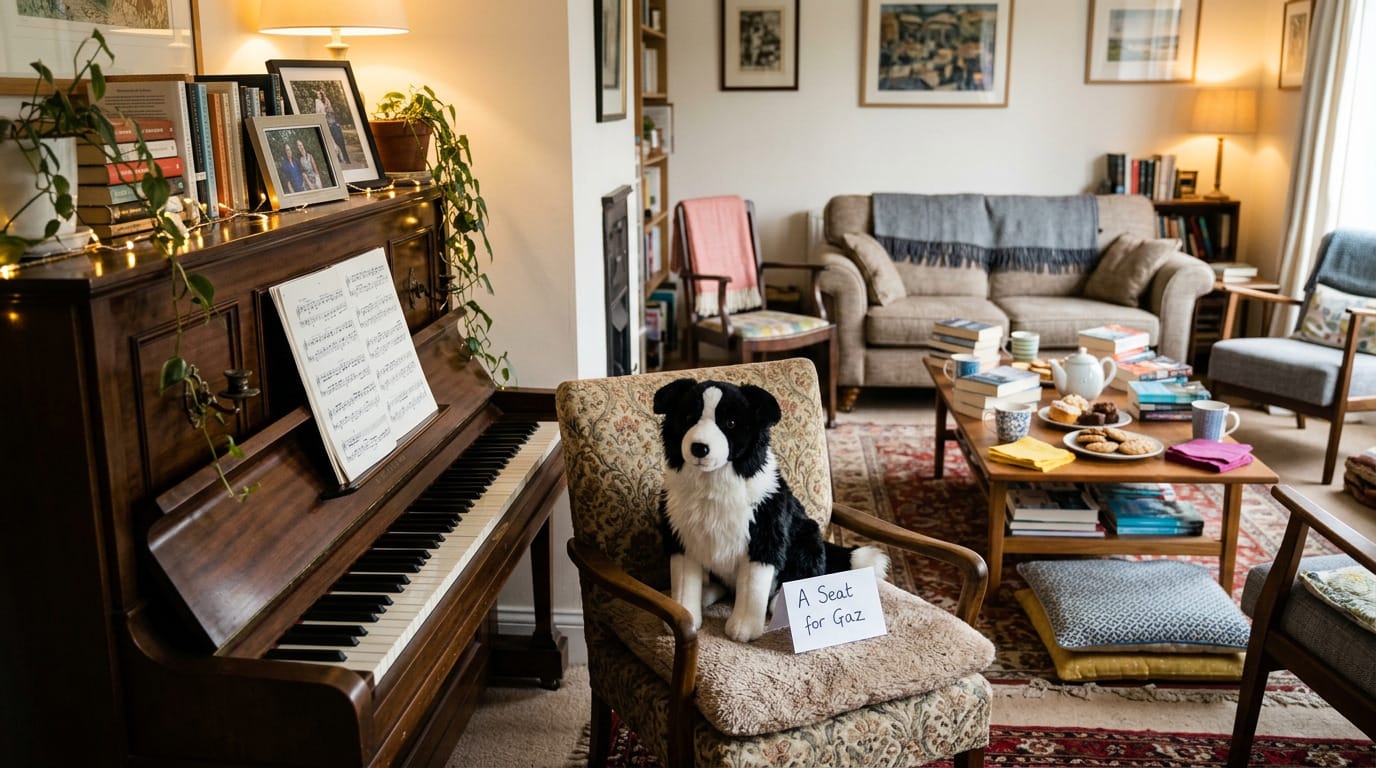
A Seat for Gaz
Place a plush border collie, or a framed photo of a black-and-white dog, on a cushion near the piano corner. Gaz goes everywhere with Livia, so he should come to book club too.
Bonfire Lanterns
Group ember-orange candles or battery lanterns on a tray of river stones to recall the bonfire where Livia finally lets the past go.
The Metronome
Set a vintage metronome on the table, ticking softly as guests arrive. It is the quiet heartbeat of every practice room Livia ever knew.

Bravo Bouquets
End with a recital tradition: a single rose or a small posy tied with ribbon at each place, a “bravo” for every member, just like the bouquets after a performance.
Mismatched Teacups
Serve coffee and tea in mismatched cups and saucers from thrift stores or your own cupboard. Like the movements of a partita, the parts are all different, and together they make something whole.

- Icebreaker: Partita Fact or Fiction Quiz (Activity in printable kit)
- Icebreaker: What’s in the Hoard? (In printable kit)
- Icebreaker: Seven Days to Decide (In printable kit)
- Icebreaker: My Life as a Partita (In printable kit)

Food in Partita is plain, honest and homemade: fried apples and pork chops on a Tennessee supper table, burgers at a Bloomington diner, and church-basement casseroles after a funeral. This menu mixes Southern farm-country comfort with a few musical flourishes.
♪ APPETIZERS
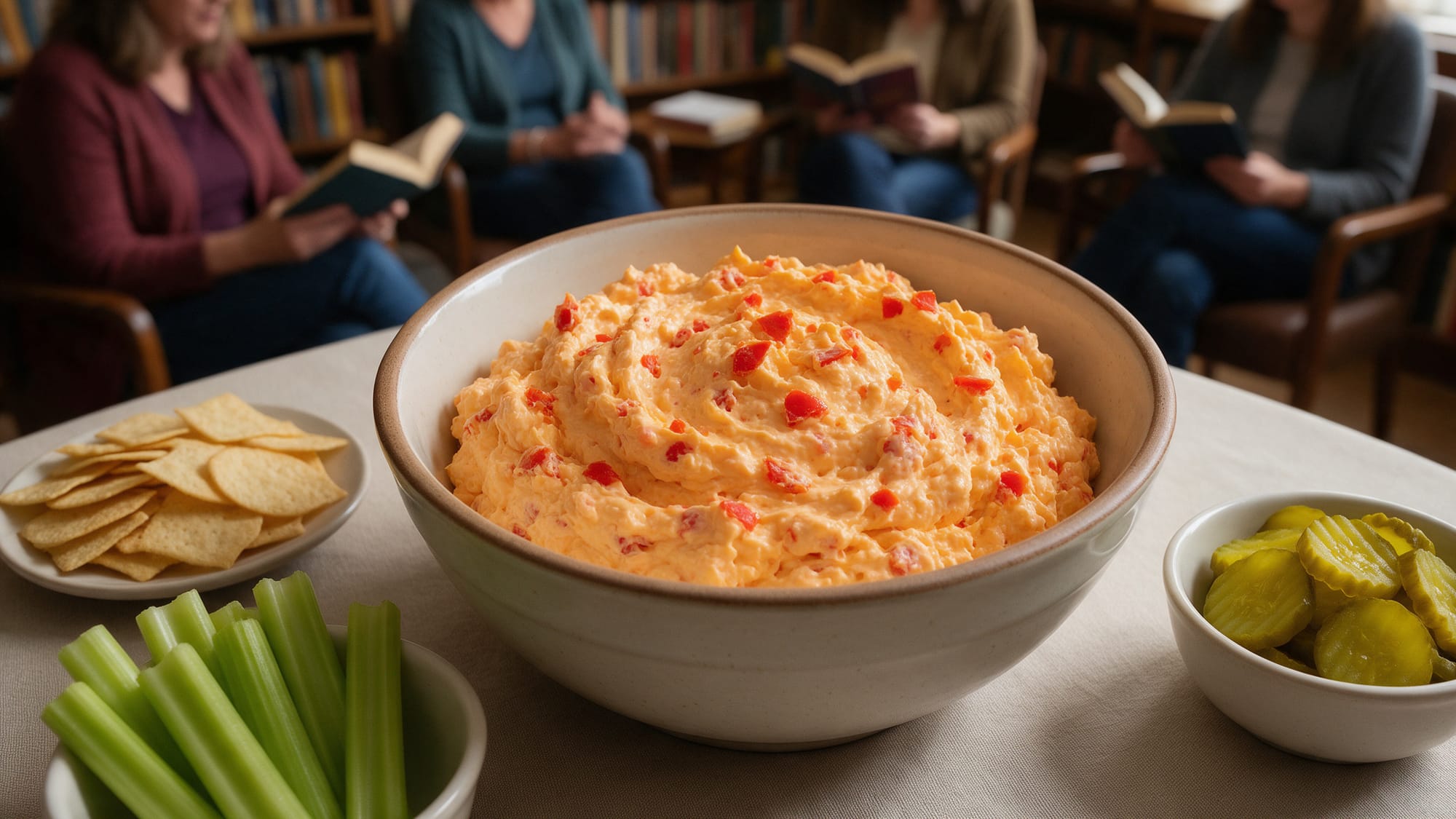
Prelude Pimento Cheese
Every good Southern gathering opens with a bowl of pimento cheese. Serve it with crackers, celery and pickles as the overture to your evening. The recipe isRecipe included in printable kit.
Amadeo’s Arancini
Golden fried rice balls with a melting mozzarella center, in honor of Amadeo, the Italian cook at Gorgo’s who fed Livia like family and saved her hand. Store-bought frozen arancini work beautifully.
CyLee Dairy Cheese Board
Named for the barn Livia’s father built for his children. Fill a board with sharp cheddar, a soft farmhouse cheese, sweet butter, apple slices, honey and crusty bread.
♪ MAIN ENTRÉES
Supper Across the Formica: Pork Chops with Fried Apples
The very meal on the stove when Sigurd calls: apples frying in the skillet and Charlie cutting up his pork chop. Juicy seared chops topped with cinnamon-glazed apples. Recipe included in the printable kit.
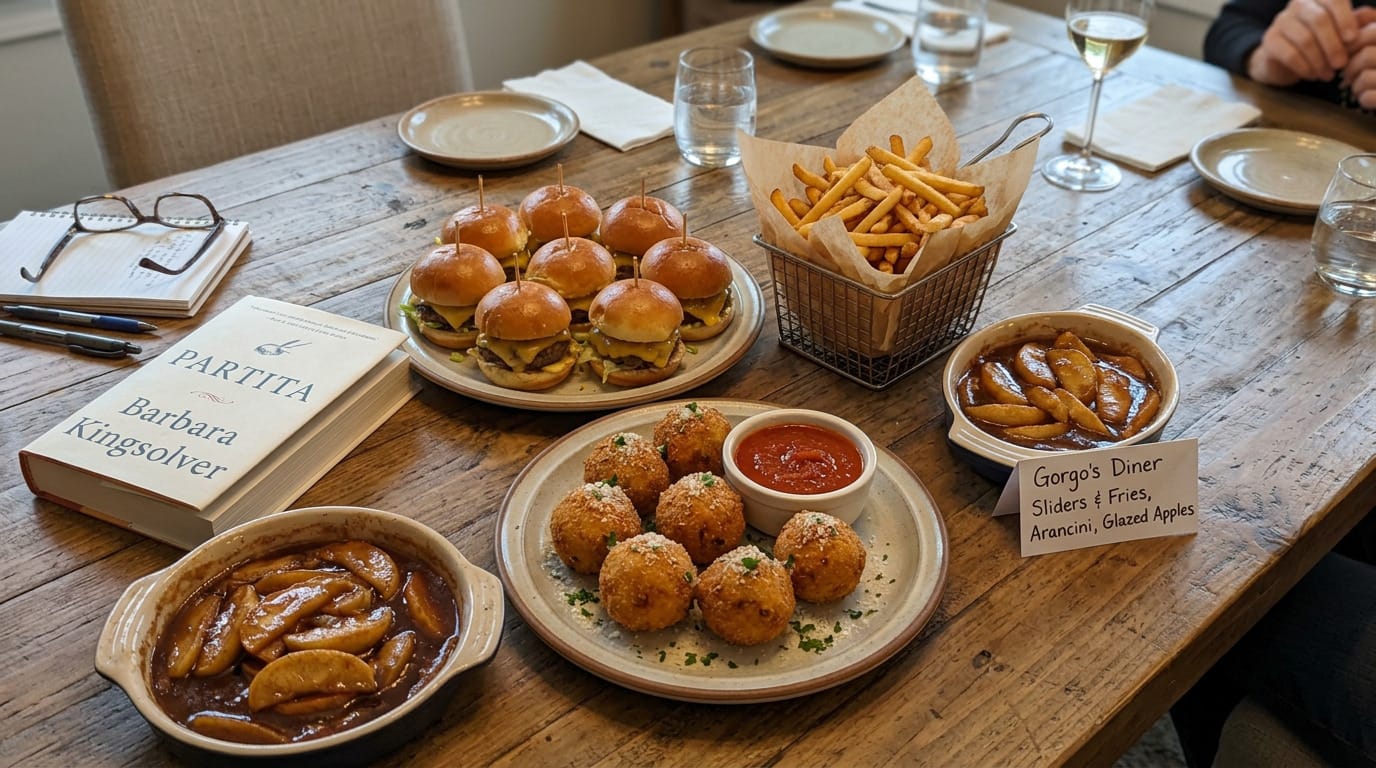
Gorgo’s Diner Sliders and Fries
The burger and fries Livia didn't remember eating at her first lunch with Sigurd, because she couldn’t take her eyes off him. Mini cheeseburgers and a basket of fries make a fun, easy buffet.
Church Supper Chicken and Dumplings
Nothing says rural Tennessee comfort like the dishes neighbors carry to the church basement after a funeral. Tender chicken and fluffy dumplings in a creamy broth.
♪ DESSERTS
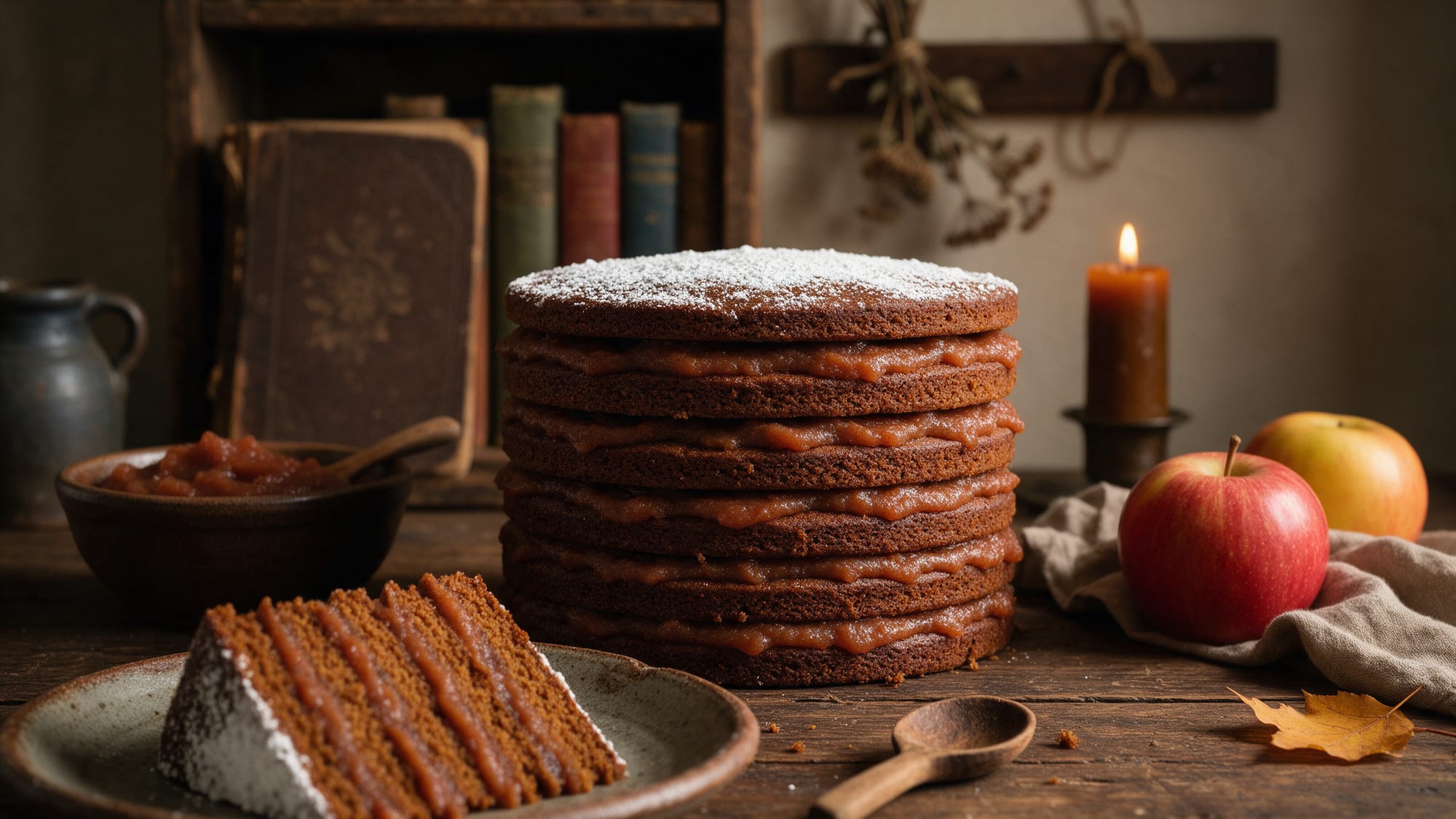
Sarabande Apple Stack Cake
The Appalachian classic: thin, molasses-spiced cake layers stacked with apple butter. Like a sarabande it is slow, deep and worth the wait, and like a partita its separate parts become one whole. Recipe included in printable kit.
Ondine’s Blackberry Cobbler
Mickie names the surprise puppy Ondine so Livia can never again say “I’ll never have Ondine.” Celebrate second chances with a warm, bubbling blackberry cobbler and vanilla ice cream.
Gaspard’s Midnight Chocolate Pie
A dark, silky chocolate cream pie for Gaspard de la nuit, “Gaspard of the night,” and for the devoted border collie who bears its name. Top with clouds of whipped cream.
♪ BEVERAGES

Front-Porch Sweet Tea
Livia stands on her porch under the “accusing stars” the night Sigurd calls. Pour tall glasses of Southern sweet tea with lemon and fresh mint.
Planets Punch
Sigurd’s nickname for Livia was “Planets.” This sparkling purple punch is dotted with star-shaped pineapple and blueberry “planets.” Recipe included in printable kit.

Bonfire Coffee Bar
Livia and Charlie share coffee while they watch the bonfire. Set out hot coffee, fresh cream, cinnamon, whipped cream and chocolate shavings, and a splash of Tennessee whiskey for grown-ups who like it.
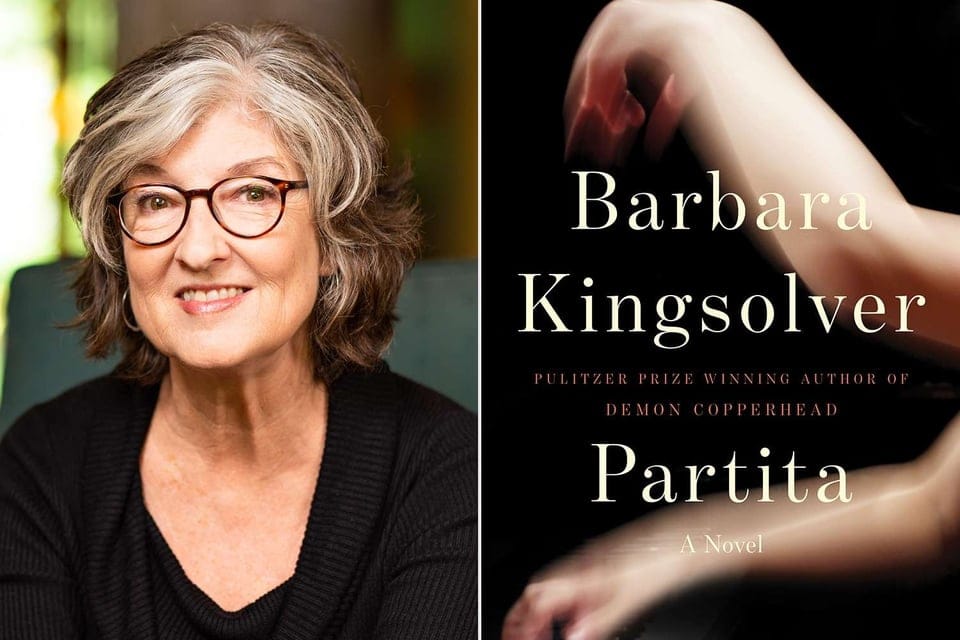
Get Barbara Kingsolver Books
Discover Barbara Kingsolver’s books—compelling stories that draw you close, stir your heart, and leave you with plenty to talk about long after the last page.
Bookshop.org was created as a socially conscious alternative to Amazon, with the goal of helping local, independent bookstores thrive. This is why Readers With Wrinkles supports their efforts. Please join us in this effort by purchasing your next read here.
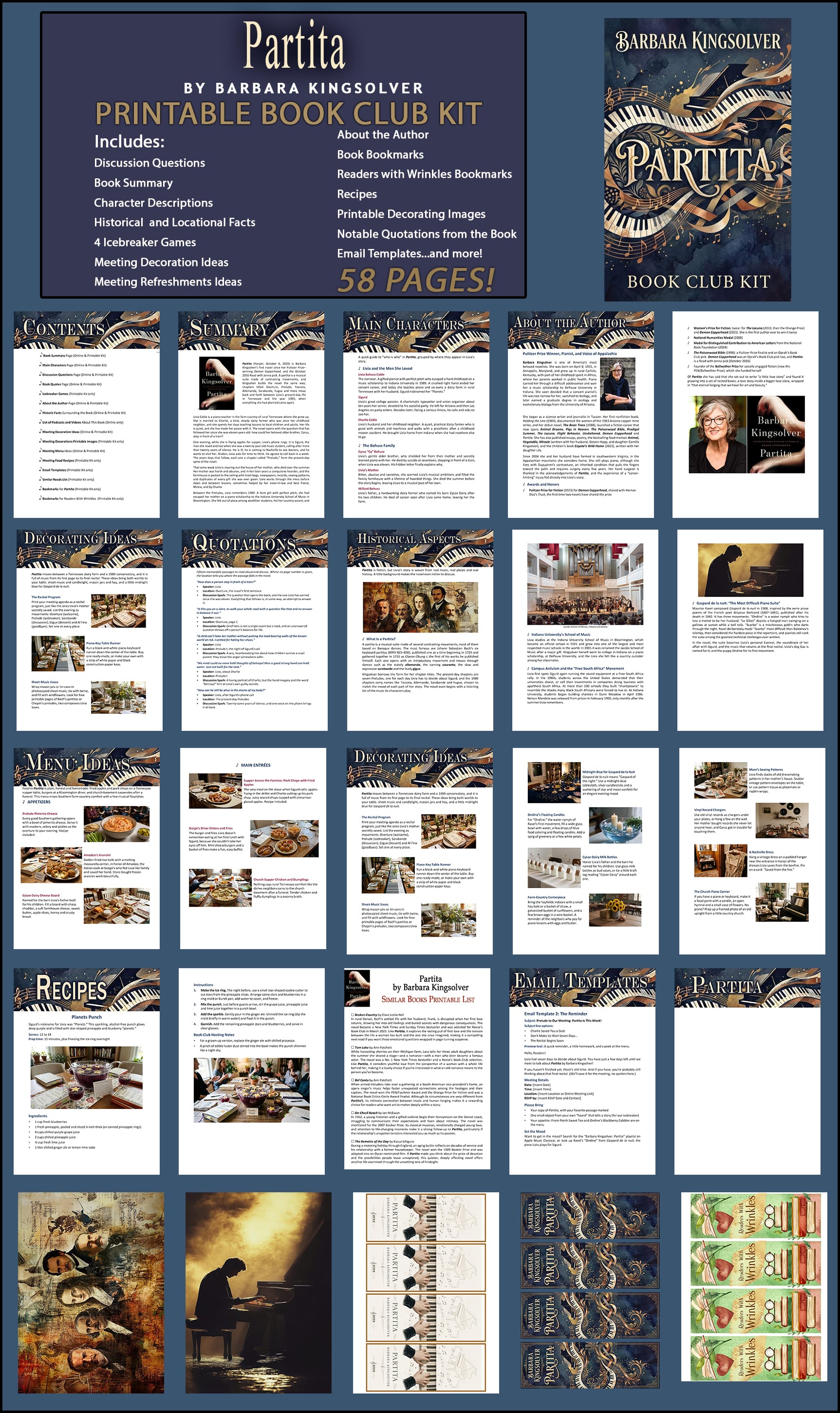
Partita printable BOOK CLUB KIT
The RWW book club kits provide everything you need to organize a great meeting with insightful discussions. These resources simplify book club preparation with character lists, book quotes, refreshment suggestions, recipes, and carefully prepared book club questions!
Comments